
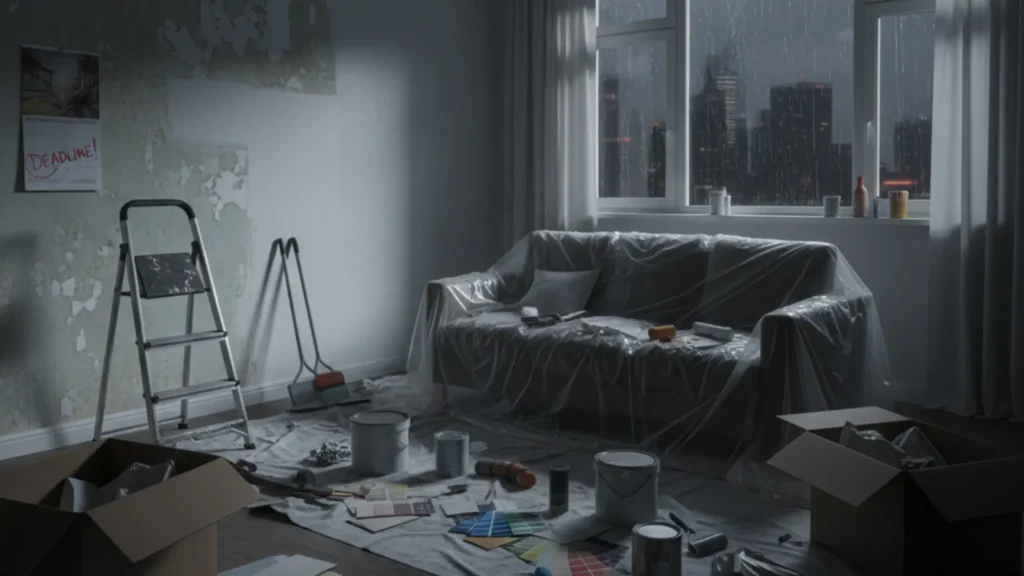
Your letting agent just called. New tenant moves in on Friday. It’s Wednesday morning. The current tenant has left your Canary Wharf flat looking like a crime scene, complete with mysterious stains on the living room wall and what appears to be an entire tin of red paint knocked over in the hallway.
So you do what everyone does: ring round looking for an emergency painter. The first three can’t do it. The fourth says they can do it Friday morning. That’s no help whatsoever, the tenant’s moving in Friday morning. The fifth says yes, they can start today, they’ll have it done by Thursday night, and you’re so relieved you don’t ask any of the right questions.
Thursday evening comes. You visit the flat. The paint’s been slapped on so fast it’s literally running in places. There are bits the painter clearly couldn’t be bothered with. The bathroom ceiling has one coat of paint over mould stains that are already bleeding through. And your emergency painter is now refusing to answer your calls because they’ve been paid and they’re onto the next panic job.
Welcome to the expensive reality of emergency painting in E14. Yes, you can get it done fast. But fast, cheap, and good quality is a triangle where you only get to pick two sides. And in an emergency, most people pick fast and cheap, then spend the next six months regretting it.
I’ve spent ten years dealing with E14 emergency painting situations, and I can tell you exactly what actually works and what definitely doesn’t.
What Actually Counts as an Emergency
Let’s be specific, because “emergency” gets thrown around a lot when what people really mean is “I’ve left it to the last minute.”
Genuine painting emergencies: Water damage that’s exposed bare plaster or substrate. Fire or smoke damage requiring immediate sealing. Vandalism or damage before a property viewing or tenant move in. Mould growth that’s got seriously out of hand and needs treating right now. Someone’s knocked a hole through a wall and it needs patching and painting before an inspection.
These are situations where delay causes actual additional damage or financial loss. They require fast response, but they also require doing the job properly because bodging emergency work often makes things worse.
Not actually emergencies: Deciding you hate your living room colour. Suddenly remembering you’ve got guests coming next week. Your landlord inspection being next month and you’ve known about it for three months. These might feel urgent to you, but they’re not emergencies. They’re poor planning.
The distinction matters because genuine emergency painting requires different logistics, different materials, and different costs than normal work. If you’re calling something an emergency that isn’t one, you’re paying emergency rates for no reason.
The E14 Emergency Problem
Getting emergency painting done in E14 is more complicated than other London areas for all the usual E14 reasons, except now everything’s compressed into hours instead of days.
Building management doesn’t do emergency approvals: If you’re in a managed Canary Wharf building, your emergency is not their emergency. They still need advance notice for contractors. They still need insurance documentation. They still need to know who’s accessing the building and when.
I’ve seen situations where someone urgently needed painting done, found an available painter, then discovered the building wouldn’t let them in without two weeks notice. The “emergency” painter then disappeared to another job because they couldn’t wait around, and the client was back at square one except now they’d wasted two days.
Professional emergency painters in E14 know which buildings have flexibility and which don’t. We know which building managers will accommodate genuine emergencies and which won’t budge. This knowledge is worth money when you’re racing against time.
Materials availability matters: Need specific paint to match existing colours? Hope whoever’s doing your emergency work has it in stock or can get it same day, because trips to the trade supplier eat hours you don’t have.
This is where having a properly equipped emergency painter makes a difference. We keep common paint types, primers, and materials in stock specifically for urgent work. A painter working from their car boot with whatever they bought cheap last month cannot handle most emergencies properly.
Access and timing compress: Normal painting work can be scheduled around building quiet hours and resident convenience. Emergency work happens when it happens, which means navigating building rules, parking restrictions, and resident complaints in real time.
Isle of Dogs properties, Canary Wharf towers, even Victorian houses in Poplar all have different access considerations that become much more challenging when you’re trying to sort everything in four hours instead of four days.
A Real Emergency: The Pepper Street Situation
Here’s a proper emergency painting situation from last year that shows both the challenges and what proper response looks like.
Friday afternoon, landlord calls. His tenant had moved out Thursday, he’d inspected Friday morning, and discovered substantial smoke damage throughout the flat. Not fire damage, but heavy smoke staining on every ceiling and most walls. Someone had clearly been smoking heavily indoors despite it being prohibited.
The problem: new tenant moving in Monday morning. Deposit paid, removals booked, tenant had given notice on their previous place. If the flat wasn’t habitable Monday, the landlord faced potential legal issues and definitely faced financial penalties.
The complication: this was a flat in a managed building on the Isle of Dogs. Building management office closed at 5pm Friday and didn’t reopen until Monday morning. No emergency access protocol existed for this kind of situation.
What we did: First, got lucky. The building manager was someone we’d worked with before on other properties. Called his mobile directly, explained the situation, and he agreed to grant emergency access over the weekend based on our existing relationship and documentation already on file.
Second, assessed the scope Friday evening. This wasn’t a quick paint over. Smoke damage needs proper sealing or it bleeds through. The ceilings in particular were badly stained and needed serious treatment.
Third, worked all Saturday. Treated the ceilings with stain blocking primer. This alone took most of the day because proper application takes time and you cannot rush it or the stains come through. Also treated the worst wall areas.
Fourth, worked Sunday. Applied proper ceiling paint. Started on walls. By Sunday evening, the main living areas were done. Bathroom and bedroom completed Monday morning before the tenant arrived at noon.
The key factors: We could respond immediately because we had appropriate materials in stock. We could access the building because we had an existing relationship with management. We knew the proper way to handle smoke damage because we’d dealt with it before. And we had the flexibility to work weekend hours when needed.
A cheap emergency painter would have slapped two coats of standard emulsion over everything, charged less, and left the landlord with stains bleeding through within two weeks. The tenant would have complained. The landlord would have faced additional costs and hassle. The cheap option would have been expensive.
What Makes Emergency E14 Painting Different
Preparation still matters: Emergency doesn’t mean skip the prep work. It means do the essential prep efficiently. If you’re covering smoke or water damage, you absolutely must use proper primer. If there’s mould, you must treat it. If there’s damaged substrate, you must at least stabilize it.
The painters who skip this in emergencies are creating problems that appear in days or weeks. Your emergency work should still be work you’re happy with in six months.
Material choices matter more: In normal work, if you choose slightly wrong paint, it’s not ideal but it’s not disaster. In emergency work where everything’s compressed, using unsuitable materials means complete failure.
Water damage requires stain blocking primers. Smoke damage requires specific sealers. High humidity environments like E14 bathrooms need moisture resistant paint even in emergencies. Use standard cheap materials in an emergency and you guarantee having another emergency soon.
Communication becomes critical: When you’ve got two days instead of two weeks, everyone needs to know exactly what’s happening and when. The client needs realistic expectations. Building management needs clear schedules. Any other trades involved need coordination.
Emergency painters who don’t communicate clearly cause chaos. You need to know exactly when work starts, what’s happening each day, and when it finishes. Vague reassurances don’t cut it when timing is this tight.
What to Look for When You Need Emergency Painting
You don’t have time for the normal vetting process, but you still need to make good decisions fast.
Can they actually start when they say? Some painters will promise anything to get the job. Then they turn up six hours late because they’re finishing something else first. Ask specific questions. Where are they right now? What are they finishing? When exactly will they arrive?
Do they have materials in stock? If they need to source materials before starting, you’re losing hours. Professional emergency painters keep stock specifically for this purpose.
Do they understand building access? For E14 managed properties, this is crucial. If they’ve never worked in your specific building or similar buildings, you’re taking a gamble.
What’s their actual plan? Anyone can say they’ll fix it fast. Ask them to explain how. What prep work do they consider essential? What materials will they use? How long will each stage take? Vague answers mean they’re making it up.
The Cost of Speed
Emergency work costs more than scheduled work. This is true everywhere, but especially true in E14 where the logistics are more complex.
Why it costs more: Materials at short notice often mean paying retail rather than trade prices. Weekend or evening work might be required. The painter has to drop other work, which means they’re losing money elsewhere. The compressed timeline means no room for errors or delays.
This isn’t a rip off, it’s reality. If you want someone to solve your problem immediately, you’re paying for their ability to drop everything and focus on you.
The false economy: Going with the cheapest emergency quote almost always costs more in the end. Cheap emergency work fails fast, then you’re paying someone else to fix both the original problem and the botched fix. The expensive route would have been cheaper.
Get Proper Emergency Response
Emergency painting in E14 requires someone who actually understands the urgency, has the materials and flexibility to respond fast, and knows how to work within E14’s specific constraints.
We handle emergency painting across E14. From water damage to smoke damage, urgent tenant turnarounds to last minute repairs. We keep materials in stock, have existing relationships with building management across the area, and can mobilize fast when it matters.
Call or WhatsApp: 07507 226422
Email: hello@havenedge.co.uk
Website: www.havenedge.co.uk
CSCS certified, fully insured, and experienced with E14 building management requirements even under time pressure.
Real emergencies need proper solutions, not panic bodges. Fast response, appropriate materials, and work that still looks good six months later. That’s what emergency painting should mean.