
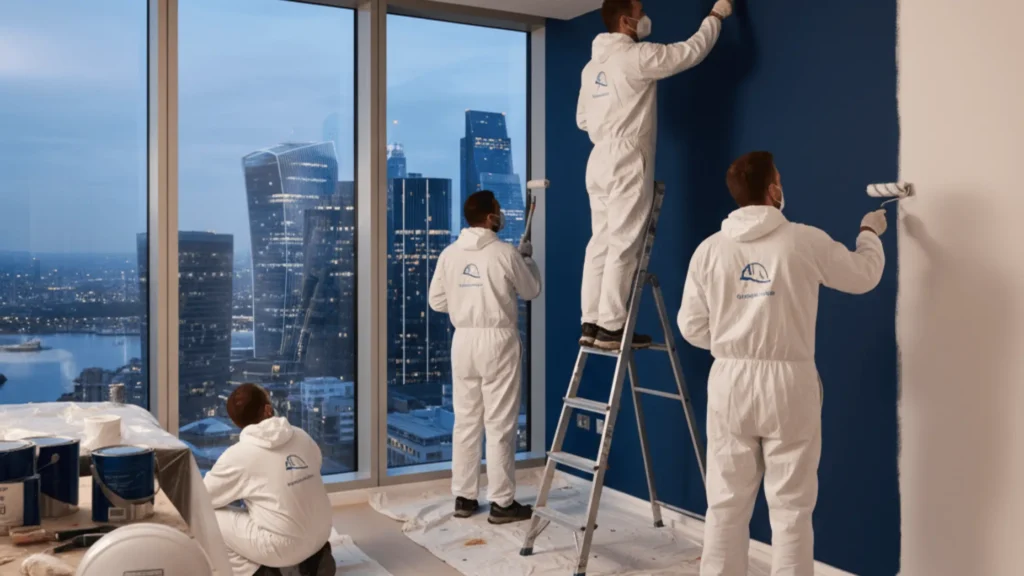
Your painter’s just been turned away at building reception. You’ve taken the morning off work to let them in. They’ve driven from the other side of London with all their equipment. And now the building security won’t let them past the lobby because they don’t have a CSCS card.
Your painter’s confused. You’re confused. Security is unmoved. They’ve seen this situation fifty times before. They point at the sign on the wall that clearly states all contractors must be CSCS certified to access the building. Your painter argues they’ve been painting for twenty years, they don’t need a card. Security doesn’t care. No card, no entry.
So now you’re standing in your lobby feeling like an idiot, your painter’s annoyed because they think it’s bureaucracy gone mad, and you’ve just wasted a day plus whatever cancellation fees are about to appear. All because you hired someone who calls themselves a professional painter but didn’t bother checking whether they actually meet professional standards for working in Canary Wharf.
Welcome to the reality of E14 building requirements. Professional here doesn’t mean “quite good at painting.” It means meeting actual documented standards that let you work in the buildings where most E14 residents actually live.
I’ve spent ten years painting across Canary Wharf and Isle of Dogs, and I can tell you the single biggest cause of failed painting projects is hiring people who think professionalism is optional.
What Professional Actually Means in E14
Strip away the marketing waffle and professional painting in E14 means meeting specific verifiable standards that most painters don’t bother with.
CSCS certification isn’t a nice to have. It’s mandatory in the majority of Canary Wharf buildings, most Isle of Dogs managed properties, and increasingly in residential towers across E14. No CSCS card means no access. Simple as that.
Yet the number of painters working in London who don’t have CSCS certification is staggering. They paint houses in the suburbs where nobody checks. They do residential work in areas without strict building management. Then they quote for E14 jobs and discover they literally cannot access the buildings.
Insurance that actually covers the work. Public liability insurance is the baseline. But not all public liability insurance is equal. Some policies have height restrictions. Some exclude certain types of buildings. Some don’t cover work in occupied residential properties.
A painter with inadequate insurance who causes damage in your Canary Wharf flat might as well have no insurance. When you claim, you’ll discover the policy doesn’t cover this specific situation, and you’re left chasing someone who probably can’t afford to pay anyway.
Documentation and compliance. Professional painters in E14 provide method statements when required. Risk assessments for building management. Proof of certification. Insurance certificates. References. All the boring administrative stuff that proves you’re legitimate.
Cowboys think paperwork is bureaucracy. Professionals understand it’s protection for everyone involved. You want proof your contractor is legitimate. Building management needs documentation for their records. Insurance requires certain procedures are followed.
The E14 Access Problem
This isn’t just about CSCS cards. It’s about understanding that E14 residential buildings operate differently to houses in Hampstead.
Building management pre approval. Most Canary Wharf and Isle of Dogs residential buildings require contractor registration before work begins. Not on the day. Days or weeks before. This means submitting documentation, getting approval, sometimes attending induction sessions.
Professional painters know this. We factor it into our timelines. We handle it before you even have to think about it. Unprofessional painters don’t know it exists until they turn up at your building and get refused entry.
Service lift coordination. High rise buildings have specific rules about using service lifts for moving materials and equipment. Book in advance. Specific time slots. Protect the lift with proper coverings. Clean up afterwards.
I’ve seen amateur painters cause thousands of pounds of damage to service lifts through carelessness, then disappear because they weren’t properly insured. The building pursues the flat owner for the damage. Professional painters know how to use service lifts properly and have insurance that covers any accidents.
Working hours and resident consideration. Most managed buildings have strict rules about when noisy work can happen. Usually weekdays only, specific hours, no early starts or late finishes. Bank holidays are often completely off limits.
Professional painters plan around these restrictions. Unprofessional ones either ignore them, causing complaints and potential work stoppages, or discover them mid job and have to completely reschedule, causing delays you weren’t expecting.
A Real Example: The South Quay Disaster
Let me tell you about a situation that demonstrates exactly why professionalism matters.
We were called to a flat in South Quay where the owner had hired a painter through a recommendation from someone who lived in a house, not a managed building. The painter was competent enough, had done good work on the friend’s terraced house. Should be fine for a flat, right?
Wrong. Multiple ways.
Day one: Painter arrived without CSCS card. Building wouldn’t let him in. Owner had to come home from work to sort it out. Building management said he could work this time but needed to get CSCS certified before returning. The painter promised he would.
Day two: Painter started work. Didn’t book the service lift. Tried to use the resident lift to bring up paint and equipment. Building management got complaints from residents. Painter was told to stop and book the service lift properly for day three.
Day three: Service lift booked, work progressing. Painter finished at 7pm. Building rules say work stops at 6pm. Two residents complained about noise. Building management issued a warning to the flat owner about contractor compliance.
Day four: Painter needed to move a radiator temporarily to paint behind it. Building management required proof he was Gas Safe certified before allowing any work on heating systems. He wasn’t. Work stopped again while finding a separate contractor to move and replace the radiator.
Day five: Painter’s insurance was queried by building management. Turned out his public liability insurance specifically excluded work in buildings over three stories. The building was fifteen stories. Technically, he’d been working uninsured all week. Building management banned him from the building immediately.
Project was now five days in with minimal progress. Owner was stressed, out of pocket, and facing potential building management action for contractor violations. The cheap hourly rate suddenly didn’t seem like such a bargain.
We took over the project. Provided all required documentation immediately. CSCS cards for our entire team. Proper insurance covering high rise work. Method statements. Risk assessments. Booked service lift appropriately. Followed building rules precisely. Completed the work professionally with zero complaints or problems.
The job cost more than the original painter’s rate. But it actually got finished, correctly, with no building management hassles, no resident complaints, and no insurance problems. That’s the difference professional makes.
What CSCS Actually Means
Let’s be specific about what CSCS certification involves, because it’s not just a card you buy online.
Construction Skills Certification Scheme is the UK standard for construction site workers. Getting a CSCS card requires passing health and safety tests, demonstrating relevant qualifications, and maintaining the certification with ongoing training.
Different card levels exist for different roles. Painters typically have either the green labourer card or the blue skilled worker card. The skilled worker card requires proving vocational qualifications like NVQs or equivalent.
Why buildings require it: CSCS demonstrates you understand health and safety standards. You know about risk management. You’ve proven basic competence in your trade. You understand legal requirements around working safely.
For building management, CSCS is an easy filter. If you can’t be bothered getting this basic certification, you’re probably not someone they want working in their building.
Why painters avoid it: Costs money. Requires passing tests. Needs renewal every five years. Some painters have worked for decades without it and resent having to prove themselves. Others simply can’t pass the tests, which tells you something about their baseline knowledge.
Professional painters get CSCS because it’s part of being professional. Unprofessional painters avoid it and limit themselves to buildings that don’t check.
The Other Professional Standards That Matter
CSCS is just the most visible standard. Professional E14 painters meet multiple standards.
Proper training and qualifications. NVQ Level 2 or 3 in Painting and Decorating. City and Guilds. Proper apprenticeship completion. Not just “I’ve been painting for years.” Actual documented training.
Training matters because painting techniques change. Materials improve. Safety standards evolve. Product specifications update. Trained painters stay current. Untrained painters use the same methods they learned twenty years ago.
Trade association membership. Bodies like the Painting and Decorating Association or Guild of Master Craftsmen require members to meet certain standards. Membership isn’t automatic. You have to demonstrate competence and maintain standards.
Not every good painter is a member. But membership indicates someone takes their profession seriously enough to affiliate with the trade body and follow their guidelines.
Public liability insurance to proper levels. Two million pounds minimum, but ideally five million for residential work in high value properties. Some Canary Wharf buildings specifically require five million pound coverage.
Insurance costs reflect risk assessment. Cheap insurance with low coverage means when something goes wrong, the insurer’s payout limit might not cover the damage. Professional level insurance actually protects you.
Professional indemnity insurance. Less common for painters but increasingly relevant. Covers situations where advice or recommendations cause financial loss. If your painter recommends specific materials that turn out unsuitable, professional indemnity covers the consequences.
Why This Matters Beyond Just Getting In The Building
Professional standards aren’t bureaucracy for its own sake. They’re protection for everyone involved.
You’re protected from liability. If your uninsured painter damages your flat or injures themselves working, you can be held liable. Professional painters with proper insurance and certification transfer that risk away from you.
Your building management doesn’t pursue you. Violations of building rules by your contractor can result in fines or restrictions on you as the owner or tenant. Professional painters who follow building requirements keep you compliant.
The work is properly documented. Professional painters provide written quotes, contracts, documentation of work completed. If problems arise later, you have records. Cowboys work on handshakes and verbal agreements that evaporate when convenient.
You have recourse if things go wrong. Professional painters with proper insurance and trade body membership can be held accountable. Someone working cash in hand with no credentials has no incentive to fix problems once they’re paid.
What Professional E14 Painting Looks Like
Let me be specific about what working with properly professional painters actually means.
Before work starts: All documentation provided unprompted. Building management notified and approved. Access sorted. Materials specified clearly. Timeline agreed. Contract signed. No surprises.
During work: CSCS cards displayed. Service lifts used properly. Building rules followed exactly. Work area protected. Daily cleanup. Regular communication. Professional behavior toward building staff and residents.
After completion: Full cleanup. All materials removed. Building areas used left as found. Final walkthrough. Any issues addressed immediately. Documentation of completed work. Guarantee provided in writing.
This isn’t special treatment. It’s baseline professionalism. But it’s rare enough that when you experience it, it feels exceptional.
Get Properly Professional Painting
Professional in E14 means meeting verifiable standards that let us work in the buildings where you actually live, and doing so to standards that protect you and produce lasting quality.
We’re CSCS certified. Fully insured for high rise residential work. Trained to NVQ standards. Experienced with every major building management company in Canary Wharf and Isle of Dogs. We handle all building coordination, follow all rules, and work to professional standards throughout.
Call for quote now: 07507 226422
Email: hello@havenedge.co.uk
Website: www.havenedge.co.uk
Work that meets professional standards, not just professional claims. Proper certification, proper insurance, proper process. That’s what professional actually means in E14.