
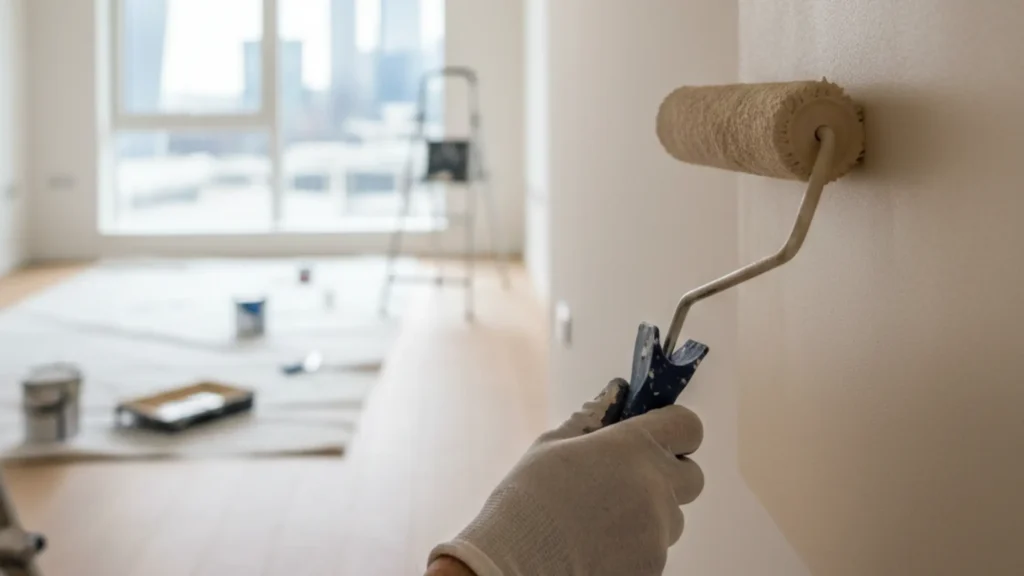
You’re on the fortieth floor of your Canary Wharf tower. Your painter’s just announced they’re “not comfortable with heights” and can’t paint your balcony. This is day two of a week long job. The balcony is literally the reason you hired a painter instead of doing it yourself. It’s the most exposed bit, needs the most attention, and now your painter’s refusing to go near it.
But it gets better. Building security’s just called. Your painter propped the flat door open while bringing materials up, which triggered a fire safety alert. That’s a breach of building regulations. There’s now a formal warning on your flat’s record. Your painter didn’t know doors can’t be propped open in fire rated corridors. They’ve worked on terraced houses for fifteen years and nobody ever mentioned it.
Oh, and they’ve just asked where to dump the old paint tins. When you explain there’s no “just throw it in a bin” option in a residential tower, that waste has to be properly disposed of according to building management procedures, they look at you like you’re speaking Martian.
Welcome to the expensive reality of hiring regular painters for high rise work. They might be brilliant at painting ground floor properties. But forty floors up in a managed Canary Wharf tower is a completely different category of work, and most painters have absolutely no idea what they’re doing.
I’ve spent ten years painting flats in E14’s residential towers, from fifteenth floor studios to penthouse apartments. High rise painting is specialist work, and treating it as standard residential painting causes disasters.
Why High Rise Painting Is Different
Regular residential painting and high rise flat painting might use the same paint, but that’s where the similarities end.
Building management requirements are extensive. Every tower has detailed contractor protocols. Pre registration weeks in advance. Insurance documentation specifically covering high altitude work. Method statements explaining exactly what you’re doing and how. Risk assessments identifying every potential hazard.
Regular painters think this is excessive bureaucracy. Specialist high rise painters understand it’s protecting everyone in a building where one contractor’s mistake could affect hundreds of residents.
Access logistics are complex. You can’t just turn up with materials in your car. Service lifts must be booked days ahead. Specific time slots allocated. Lift protection required. Loading bay coordination needed. Some buildings charge for service lift use.
Regular painters discover this on arrival and waste hours sorting access. High rise specialists handle it weeks before starting, so day one is actually working, not admin.
Working at height has legal implications. Any work involving balconies, external areas, or high level interior work falls under working at height regulations. This requires specific training, appropriate insurance, proper risk assessment, and sometimes special equipment.
Regular painters either refuse this work when they see it, attempt it without proper precautions creating liability, or bodge it from inside through closed balcony doors because they’re uncomfortable outside.
Fire safety regulations are strict. Residential towers post Grenfell have intensified fire safety requirements. Doors can’t be propped. Materials storage must meet fire safety standards. Certain products are restricted. Hot works require special approval.
Regular painters are used to doing whatever’s convenient. High rise work means following rules that exist for very good reasons.
Resident consideration is mandatory. Working in occupied high rises means navigating shared spaces, coordinating with multiple neighbours, managing noise, controlling odours in enclosed hallways, protecting common areas.
Regular painters treat residential towers like individual houses and cause complaints. High rise specialists understand we’re working in a community where our actions affect dozens of people.
The Canary Wharf Tower Challenge
E14’s residential towers aren’t just tall. They’re specifically challenging in ways that catch inexperienced painters completely off guard.
Modern sealed construction. These towers are engineered for energy efficiency, which means they’re essentially sealed boxes. Minimal air exchange unless ventilation systems are running. This affects paint drying times, odour dispersal, and moisture management.
Paint that dries in four hours in a Victorian terrace with sash windows takes eight hours in a sealed tower flat. Painters who don’t understand this schedule based on normal drying times, then discover nothing’s drying when expected. Projects overrun, quality suffers.
Building management variety. Different towers have wildly different protocols. Landmark East operates completely differently than One Canada Square residential operates completely differently than Pan Peninsula. Each has unique requirements.
Painters who work in one tower and think they understand all towers get caught out constantly. High rise specialists know each building’s specific requirements because we’ve worked in them repeatedly.
Balcony complications. Canary Wharf tower balconies face extreme conditions. Wind, weather, pollution, salt spray from the Thames funnelling up high buildings. Paint that works on ground level patios fails on fortieth floor balconies.
Regular painters use standard exterior paint and wonder why it fails. High rise specialists understand exposure levels require specific paint grades and application techniques.
The glass factor. Floor to ceiling windows in many Canary Wharf flats create massive light exposure. Paint colour shifts dramatically throughout the day. What looks perfect at 9am looks completely different at 4pm when western sun floods in.
Experienced high rise painters warn clients about this and recommend testing colours at different times of day. Regular painters just paint what you specify and leave you disappointed when the colour isn’t what you expected in real conditions.
A Real Project: The Hertsmere Road Tower Problem
Here’s a project that demonstrates exactly why high rise work needs specialists.
Client owned a flat on the twenty eighth floor of a Hertsmere Road tower. Hired a painter based on excellent reviews from suburban house jobs. Seemed professional, good portfolio, reasonable quote.
The problems started before work began. The painter had never worked in a managed high rise. Didn’t know about contractor registration requirements. Turned up first day without having pre registered. Building security wouldn’t let him access.
Client had to spend hours on phone with building management trying to arrange emergency access. Eventually got temporary permission for that day only, but painter had to provide full documentation before returning. Lost entire first day to admin.
Day two: Painter started work but hadn’t booked service lift. Tried using resident lift with paint and equipment. Building management got immediate complaints. Painter was told work had to stop until service lift properly booked for day three onwards.
Day three: Work finally progressing. Painter’s insurance was queried by building management. His public liability policy had a height restriction. Covered work up to twenty feet, not twenty eight floors. Building insisted on proof of high altitude coverage.
Turned out his insurance didn’t cover high rise residential at all. He’d been working uninsured. Building management stopped the work immediately and barred him from the building. Client was back at square one, except now building management had formal complaints logged against their flat.
We took over the project. Provided all required high altitude insurance documentation immediately. Building management approval already on file from previous work in that tower. Service lift pre booked for our entire schedule. Fire safety procedures followed precisely. Balcony work done properly with appropriate equipment and training.
The complications we expected. The flat’s balcony required specific marine grade paint because of exposure at that height. The sealed environment meant extended drying times we’d factored into schedule. The hallway access timing had to coordinate with building cleaning schedules we already knew about.
None of these were surprises to us because we work in these towers constantly. Every complication the first painter discovered the hard way, we already knew and planned for.
Project completed smoothly with zero building management issues, zero resident complaints, and work that’s properly suitable for the high altitude environment.
What High Rise Expertise Actually Involves
Let me be specific about what separates regular painters from high rise specialists.
Documentation and compliance. We maintain insurance specifically covering high altitude residential work. We have method statements template for tower work. We understand fire safety requirements. We know what building management needs without being asked.
Regular painters discover these requirements one building at a time through failed access attempts.
Working at height capability. Proper training and certification for working at height. Appropriate equipment for balcony access. Understanding of wind exposure and weather limitations. Comfort working on high level balconies safely.
Regular painters either can’t do this work or attempt it dangerously, creating liability.
Building relationship management. We know the major building management companies in Canary Wharf. We have existing relationships with property managers. We understand each tower’s specific quirks and requirements.
Regular painters treat every building as new and unknown, wasting time on procedures we already know.
Material knowledge for altitude. Understanding that paint exposed to fortieth floor conditions needs different specification than ground level paint. Knowing which products withstand wind exposure, temperature fluctuation, and intense sun.
Regular painters use standard products and wonder why they fail prematurely at altitude.
Resident consideration. Understanding how to work in occupied high rises without causing complaints. Timing, noise management, hallway protection, elevator etiquette. The soft skills that prevent problems.
Regular painters do what’s convenient for them and generate resident complaints that become building management problems that become your problems.
The Specific Buildings We Know
E14’s high rise landscape includes dozens of residential towers, each with unique characteristics.
Canary Wharf Estate towers: One Canada Square residential, Landmark East, Pan Peninsula, Baltimore Tower. Each has specific management requirements we know intimately.
Isle of Dogs developments: New Providence Wharf, Riverwalk, Harbinger. Different management companies, different access procedures, different resident expectations.
Pepper Street and surrounding: Multiple towers with varying ages and build quality. Each needs different treatment based on construction type and environmental exposure.
We’ve worked in virtually every major residential tower in E14. We know their layouts, their management, their building specific requirements. This knowledge means your project proceeds smoothly instead of becoming a learning experience.
What to Demand from High Rise Painters
If you’re considering painters for your tower flat, verify these specifics.
Insurance that specifically covers high altitude work. Not just public liability, but liability that covers work in buildings over specific heights. Most standard policies exclude high rise work. Many painters don’t realize this until building management checks.
CSCS certification for tower access. Virtually all Canary Wharf residential towers require this. Non negotiable for building management approval.
Documented experience in similar buildings. Not just “we’ve done flats before.” Specific experience in residential towers. References from building management companies if possible.
Understanding of building specific requirements. Ask them to explain the building management approval process. If they’re vague or dismissive, they don’t know what they’re dealing with.
Capability for balcony work. If your flat has a balcony, verify they can actually access and work on it safely and legally. Many can’t.
Get Proper High Rise Expertise
High rise flat painting requires understanding building management systems, working at height safely, navigating complex access logistics, and using materials appropriate for altitude exposure.
We specialize in Canary Wharf and Isle of Dogs residential towers. Proper high altitude insurance. CSCS certification. Documented relationships with major building management companies. Experience working on balconies at height. Understanding of tower specific requirements.
Call for quote now: 07507 226422
Email: hello@havenedge.co.uk
Website: www.havenedge.co.uk
From Landmark East to Pan Peninsula, New Providence Wharf to Baltimore Tower, we know E14’s residential towers. Proper access coordination, appropriate materials for altitude, and building management compliance throughout.
Whether ground floor flat or penthouse, small studio or family apartment, every high rise project gets the specialist expertise these unique properties require. That’s what high rise painting should mean.