
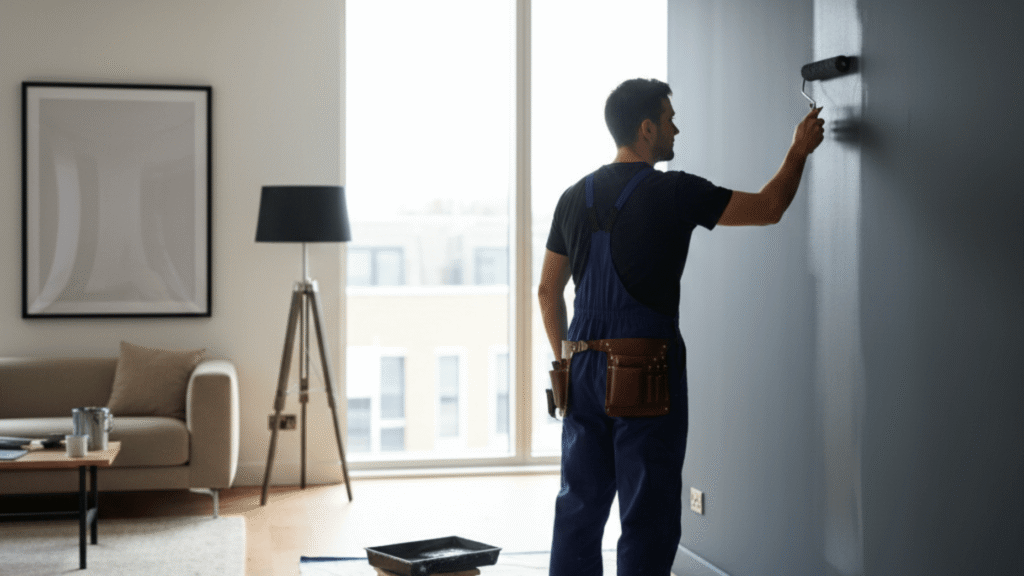
Your studio flat is 350 square feet. You’ve hired a painter who normally does three bed houses. They’ve quoted you a full day rate because “it’s still a day’s work, mate.” Fair enough, you think. Small space, should be done quickly, reasonable enough.
Except they’ve just moved your sofa bed into the tiny bathroom because they need to paint the walls. Now you can’t access the loo. The kitchenette cupboards are all stacked in the hallway blocking your front door. Their dust sheets have covered your only window, so the flat’s pitch black and you’ve had to turn all the lights on. And they’ve announced they need to come back tomorrow to finish because they “didn’t realize how much edge work there’d be in a studio.”
You’re now living in chaos for two days instead of one. Your bedroom, living room, kitchen, and dining room are all the same room, so when that room’s uninhabitable, your entire flat is uninhabitable. You’ve had to book a hotel for tonight because there’s literally nowhere in your flat you can exist while paint dries with furniture stacked everywhere.
Welcome to the expensive reality of hiring painters who don’t understand studio flats. Small spaces need completely different logistics, different techniques, and different working methods. Painters who treat them like miniature houses cause maximum disruption for minimum space.
I’ve spent ten years painting studios across Canary Wharf and Isle of Dogs, and I can tell you the difference between painters who get small spaces and painters who absolutely don’t.
Why Studio Flats Are Their Own Category
Studio painting isn’t just “less work than a bigger flat.” It’s fundamentally different work with unique challenges.
Everything affects everything. In a three bed house, you paint the bedroom while the client uses the kitchen. Paint the kitchen while they use the living room. Each room is isolated. In a studio, there’s no isolation. When you’re painting, the entire living space is compromised.
Painters who don’t understand this cause complete disruption. Specialist studio painters work in sections and phases so clients always have some usable space.
Furniture logistics are critical. In houses, furniture gets moved room to room. In studios, there’s nowhere to move it to. Every piece has to be strategically positioned so painting can happen around it.
Regular painters create furniture chaos that makes the flat unlivable. Studio specialists choreograph furniture movement like Tetris, minimizing disruption.
Ventilation is compromised. Studios typically have limited windows. When you’re painting, odours concentrate fast with nowhere to disperse. This affects both the painter’s working conditions and the client’s ability to occupy the space.
Experienced studio painters use low odour products and time work to maximize ventilation. Generic painters use standard paint and wonder why the smell lingers for days in small enclosed spaces.
Edge work dominates. Studios have proportionally more edges relative to wall space. More door frames, more window frames, more fitted furniture edges, more corners where walls meet in small recesses.
This means cutting in takes proportionally longer than rolling. Painters who quote based on floor area alone underestimate studio complexity and either lose money or rush the edge work, resulting in poor quality.
Access is tight. Ladders in studios are challenging because there’s limited floor space. Reaching high corners and ceiling edges requires careful positioning with furniture in the way.
Big space painters bring standard equipment. Studio specialists understand space constraints and adapt equipment accordingly.
The Canary Wharf Studio Challenge
E14 studios, particularly in Canary Wharf, present specific additional complications.
These are investment properties with high turnovers. Many Canary Wharf studios are buy to let, with tenants turning over annually. Painting happens during short void periods between tenants. Time pressure is intense.
Painters who can’t work efficiently in confined spaces cause delays that cost landlords weekly rent. Fast studio specialists minimize void periods.
Building management access restrictions apply. High rise Canary Wharf studios have all the building management requirements of larger flats but with tighter logistics. Service lift bookings for tiny amounts of materials. Contractor access protocols. All the admin for 350 square feet.
Experienced E14 studio painters handle this efficiently. Newcomers waste time on admin that seems disproportionate to the job size.
The quality expectations are high. Small space means everything’s visible. There’s no “guest bedroom nobody uses” where imperfections don’t matter. Every inch is lived in constantly. Quality must be consistently high throughout.
Budget painters sometimes treat studios as quick jobs where precision doesn’t matter. The residents living in 350 square feet notice every flaw.
Clever storage maximization is everywhere. Modern Canary Wharf studios have fitted storage, murphy beds, fold away furniture, built in everything. Painting around these requires understanding how they work.
I’ve seen painters damage expensive fitted furniture through ignorance. Studio specialists understand modern compact living features.
A Real Project: The Pan Peninsula Studio Disaster
Here’s a situation that perfectly illustrates studio specific challenges.
Client owned a studio investment flat in Pan Peninsula. Tenant moved out, standard redecoration needed before new tenant. Hired a painter who did excellent work on houses based on landlord recommendation.
The quote seemed great. Lower than expected because “it’s only one room.” Should be finished in a day. Easy job.
Day one reality was different. The painter arrived with equipment for normal sized rooms. Step ladder that was too tall for the ceiling height and couldn’t position properly. Roller pole too long. Dust sheets too big.
Started moving furniture but had nowhere logical to put it. Ended up stacking everything in the bathroom and hallway, completely blocking access. Realized they couldn’t work like this, had to rearrange. Lost an hour.
The edge work problem emerged. The studio had a kitchenette, bathroom door, front door, built in wardrobe, large window, two radiators, and multiple electrical outlets, all in 350 square feet. The edge work took much longer than estimated.
By end of day one, only walls were done, not ceiling or woodwork. Painter had to return day two. Client’s new tenant was moving in day three. Tight timing suddenly very tight.
Day two brought more problems. Painter needed to paint ceiling but the murphy bed was in the way. Couldn’t figure out how to fold it properly. Eventually just painted around it as best as possible, leaving visible unpainted areas where bed mechanism sits.
The bathroom needed painting but the furniture stacked there prevented access. More rearranging, more time wasted.
The final quality issues. In the rush to finish, several problems appeared. Paint roller marks visible on walls because small space meant painter couldn’t maintain wet edge properly. Cutting in around built ins was messy because painter wasn’t used to working in tight spaces with furniture cramping their movement.
Client ended up calling us to fix the rushed work before new tenant arrived. We repainted sections properly, working in the confined space as it’s meant to be worked.
What we did differently: Brought compact equipment appropriate for studio size. Planned furniture movement sequence before starting so nothing blocked itself. Worked in phases so bathroom always remained accessible. Used proper compact space techniques for cutting in. Completed everything in scheduled time because we understood studio logistics.
Same space, same work, completely different execution because one approach understood studios and one didn’t.
What Studio Flat Painting Actually Requires
Let me be specific about techniques and logistics that separate studio specialists from general painters.
Phased working. Never render entire flat unusable at once. Paint one section, let it dry with furniture pushed to opposite section, then reverse. Client always has some functional space.
General painters clear everything at once for efficiency. Studio painters prioritize client livability over their own convenience.
Compact equipment. Small ladders, short roller poles, appropriately sized dust sheets. Equipment that fits the space rather than making space fit equipment.
House painters bring house equipment. Studio specialists bring studio appropriate gear.
Furniture choreography. Every piece gets moved minimum times in logical sequence. Nothing blocks critical access like bathroom or front door unnecessarily. Everything has a planned position for each phase.
Amateur studio painters move furniture randomly multiple times, causing chaos.
Edge work mastery. Studios are proportionally all edges. Cutting in must be precise because it’s the majority of visible work. Takes skill and patience in cramped conditions.
Rushed painters do sloppy edge work that dominates the visual result in small spaces.
Low odour products. Critical in small spaces with limited ventilation. Clients must often occupy the flat during drying. Strong odour products make this intolerable.
Budget painters use whatever’s cheap. Studio specialists specify products appropriate for confined spaces.
Realistic scheduling. Understanding that studio complexity often takes as long as much larger spaces because of logistics and edge work. Not quoting based on square footage alone.
Inexperienced painters underquote studios, then rush to minimize losses, producing poor work.
The Small Space Advantages
Not everything about studios is challenging. Some things are genuinely easier for professional painters.
Less material waste. Small quantities needed. Can use premium products affordably because volumes are low. Every surface gets attention because there’s not much surface.
Good studio painters recommend quality materials because the quantity cost is minimal. The flat gets brilliant finish for reasonable total material cost.
Quick turnaround when done properly. With correct logistics and equipment, studios are genuinely fast. Completed in single day often. Client disruption is brief.
This only works when the painter actually understands studio work. Otherwise it drags over multiple days unnecessarily.
Attention to detail is economical. In large houses, perfect finish everywhere is expensive. In studios, perfect finish everywhere is achievable within reasonable budgets because there’s not much “everywhere.”
Studio flats can achieve genuinely premium quality results affordably.
What Landlords Need to Know
For investment studios in Canary Wharf, additional considerations matter.
Tenant turnover frequency. These flats often need redecorating annually. Establishing relationship with reliable studio specialist saves hassle every time.
Different painter every year means different quality, different timings, different problems. Same painter every year means efficient routine.
Void period minimization. Every day empty costs rent. Painter who can complete reliably in one day versus painter who takes three days is worth premium.
The slightly cheaper quote that causes delays costs more in lost rent.
Touch up economics. Small flats mean small touch ups. Painters who handle these efficiently for minimal cost maintain good landlord relationships.
Painters who can’t be bothered with small jobs aren’t useful for studio landlords needing regular minor work.
What Owner Occupiers Need to Know
Living in a studio while decorating it requires particular consideration.
Timing the work. Ideally done when you can be out for a day. Even best studio painters need some hours where flat’s genuinely unusable.
Trying to work from home while your home’s being painted in 350 square feet is miserable.
The smell factor in small spaces. Even low odour paint is noticeable in confined spaces. Plan to ventilate thoroughly and maybe sleep elsewhere the first night.
Painters should warn you realistically about this. Many don’t.
Long term planning. Studios need repainting more frequently than larger spaces because every inch shows wear. Budget for decorating every few years.
Good studio painters can do maintenance refreshes efficiently, keeping costs reasonable.
Get Proper Studio Expertise
Studio flat painting requires understanding compact space logistics, appropriate equipment, phased working to minimize disruption, and techniques specific to small spaces.
We specialize in Canary Wharf and Isle of Dogs studios. We understand the building management requirements, the space constraints, the need for efficient scheduling, and the techniques that produce quality results in compact spaces.
Call for quote now: 07507 226422
Email: hello@havenedge.co.uk
Website: www.havenedge.co.uk
From Pan Peninsula studios to Baltimore Tower compact flats, we work in E14’s small spaces constantly. Proper logistics planning, appropriate equipment, low odour products, and working methods that minimize your disruption.
Whether investment property needing quick turnaround or home needing careful decoration, studio flats deserve specialists who understand their unique challenges and advantages.