
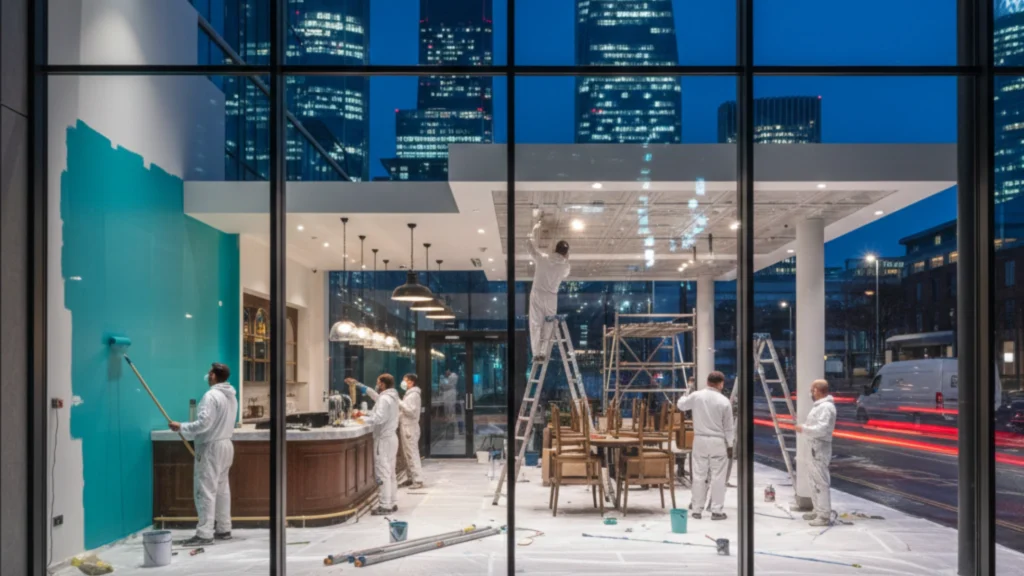
Your café reopens Saturday evening. Grand relaunch. New menu. New branding. New everything. You’ve spent three months planning this. Social media campaign running all week building genuine anticipation. Press coverage arranged. Two hundred reservations confirmed for opening night because your regulars are actually excited about what’s coming.
The painters were supposed to finish Thursday. It’s Friday afternoon and they’re still working on the back wall of the dining area. The kitchen hasn’t been touched because they couldn’t start it until the dining area was done. The wall behind the counter has one coat showing old grease stains bleeding right through because nobody properly cleaned and sealed the surface before painting started.
And the smell. Fresh paint smell throughout the entire café. You opened every window Thursday evening hoping it would air out overnight. It hasn’t. Friday morning customers walking past on Commercial Road can smell it from outside. Saturday evening your first guests are walking into a café that smells like a decorating shop rather than somewhere they want to spend their evening enjoying your new menu.
The painter had done stunning work on a Canary Wharf flat the previous week. Beautiful results. Genuinely talented. But had never painted a hospitality space before and didn’t understand that café painting operates under completely different rules to residential work.
Welcome to the expensive disaster of hiring residential painters for restaurant and café environments. Every hospitality business in E14 needs painters who understand that a café isn’t a flat with tables in it. It’s a commercial food and beverage environment with specific requirements that residential painters have simply never encountered.
I’ve spent ten years painting restaurants and cafés across Canary Wharf, Poplar, and Limehouse. Getting these spaces genuinely right requires understanding hospitality operations, food safety requirements, and the unique pressure of opening night deadlines that residential painting doesn’t face.
Why Café and Restaurant Painting Is Its Own Discipline
A café wall looks identical to any other wall. Same plaster, same surface, same everything visible to the naked eye. But the invisible contamination on that wall, the products required to paint it properly, and the conditions it needs to withstand afterwards are completely different to anything a residential painter encounters.
The grease contamination is invisible but devastating. Commercial kitchens produce grease constantly. This grease travels through the air and deposits on every surface in the café, not just kitchen walls. Dining area walls, the area behind the counter, ceiling surfaces, all accumulate invisible grease layers over months and years of operation.
Paint simply does not adhere properly to grease contaminated surfaces. A wall that looks perfectly clean might have enough invisible contamination to cause complete paint failure within weeks. Standard surface cleaning doesn’t remove this contamination. Specialist degreasing does. Residential painters have never encountered greasy walls because residential walls aren’t greasy. They clean with standard prep and assume that’s sufficient. On café walls, it categorically isn’t.
The kitchen humidity affects everything nearby. Commercial kitchens generate significant humidity that travels into dining areas and affects paint performance on every nearby surface. Paints specified for hospitality environments account for this ongoing humidity exposure. Residential paints don’t and deteriorate noticeably faster in café conditions.
The opening night deadline is genuinely absolute. Your café opens Saturday. Customers are arriving regardless of whether the painting is finished. This hard deadline means every element needs planning backwards from opening night. Drying times, airing requirements, final checks, all calculated from when the café needs to be ready rather than from whenever the painter feels like starting.
The ambiance is commercially critical. People choose cafés and restaurants partly based on atmosphere. The colours, the finish quality, the overall visual impression all contribute to whether a space feels welcoming or forgettable. A badly painted café doesn’t just look unprofessional. It actively undermines the experience you’re trying to create for customers.
The E14 Hospitality Painting Challenge
E14’s restaurant and café scene presents specific complications that intensify every aspect of hospitality painting.
Food hygiene inspectors check wall condition specifically. Cafés and restaurants are subject to regular inspections where peeling paint, inappropriate paint types in food preparation areas, or visible deterioration can affect hygiene ratings directly. Professional hospitality painters understand these requirements automatically. Residential painters working in a café might inadvertently create a hygiene issue they didn’t know existed.
After-hours access in managed buildings adds complexity. Many E14 cafés operate within managed commercial buildings with strict after-hours contractor protocols. Weekend and overnight access requires advance authorisation that residential painters haven’t encountered before. Every day lost sorting access is a day closer to opening night with work still unfinished.
The Instagram expectation genuinely raises the aesthetic standard. Independent cafés in Canary Wharf and Limehouse compete partly on visual appeal. A beautifully painted feature wall becomes shareable content that drives new customers through genuine social media marketing. The aesthetic standard for café painting in E14 is higher than standard commercial work because the visual presentation is part of the business’s marketing strategy.
Closure periods cost revenue directly and immediately. Every day a café stays closed for painting is lost income, lost customer habit, and lost momentum. Painters who underestimate hospitality timeline pressure create extended closures that genuinely damage the business financially.
A Real Project: The Commercial Road Café
Independent café on Commercial Road, Limehouse. Gorgeous space with real character, but the previous owner had left it looking tired and dated after years of minimal maintenance. New owner had completely reimagined the concept and needed everything painted to match their fresh brand identity before the grand reopening.
Opening night was set for a Saturday. Non-negotiable. Social media campaign already running. Press coverage arranged. Two hundred reservations confirmed. The business simply could not afford to delay.
They hired a painter with excellent residential reviews across E14. Talented painter, impressive portfolio of Canary Wharf flat redecorations. But had never painted a hospitality space before.
The preparation failed immediately. The painter cleaned all surfaces with standard prep solution. Everything looked clean. Felt clean. But years of café operation had deposited invisible grease residue throughout the dining area and behind the counter. First coat went on beautifully. By the second coat, grease contamination was already causing the paint to lift in patches along the upper walls where deposits were heaviest. Adhesion failure was happening within hours, not weeks.
The kitchen area created a genuine hygiene concern. Standard commercial emulsion was used in the food preparation area. Standard commercial emulsion isn’t food-safe. Food preparation areas require specific food-grade paint meeting hygiene standards. A routine inspection visiting during this period could have resulted in a hygiene rating downgrade that would have been genuinely damaging to the new business.
The feature wall deteriorated almost immediately. The owner wanted a stunning dark forest green feature wall behind the main seating area. Beautiful colour choice, genuinely striking. But standard interior emulsion was specified, completely wrong for a surface constantly exposed to kitchen humidity and daily café wear. Within two weeks of reopening, moisture damage was appearing along the lower sections where humidity settled. The dark colour made every spot and mark immediately visible to anyone sitting at nearby tables.
The paint smell ruined opening night. Painters finished Thursday evening. Opening was Saturday. Fresh paint smell throughout the entire space. Fans and open windows reduced it but didn’t eliminate it. First guests Saturday evening noticed immediately. Several commented publicly. One couple actually left and returned the following week instead, which is exactly the impression no new café wants to make on opening night.
We remediated everything properly. Specialist degreasing of every surface before repainting. Food-safe products in all kitchen and preparation areas. Hospitality-grade finish on the feature wall designed to withstand café humidity indefinitely. Scheduled remediation work with proper airing time built into the timeline before the café reopened for the following week’s service. The result looked genuinely stunning and lasted because every surface was treated with products actually suited to the environment.
What Hospitality Painting Actually Requires
Let me be specific about what understanding café environments actually means for painters.
Specialist degreasing before anything else happens. Every café surface needs professional degreasing before paint goes near it. Not standard surface cleaning. Specialist degreasing that removes invisible contamination standard prep doesn’t touch. This is the single most critical preparation step in hospitality painting and the one residential painters most consistently skip because they’ve never encountered it.
Food-safe paint in all food preparation areas. Kitchen walls, prep areas, anywhere food is prepared or stored requires food-grade paint meeting hygiene standards. This is a food safety requirement, not a preference. Hospitality painters specify it automatically without being prompted.
Humidity-resistant products throughout the space. Kitchen humidity affects every surface in the café, not just kitchen walls. Hospitality-grade paint systems account for this ongoing humidity exposure. Residential products deteriorate much faster in café conditions and show it within weeks.
Proper airing time built into the schedule. Paint smell in a food service environment is both a serious customer experience problem and a potential hygiene consideration. Work needs completing far enough before service resumes that smell has genuinely dissipated completely.
Washable and durable finishes everywhere customers see. Café walls endure constant physical contact, splashes near service areas, and general hospitality wear that residential walls simply don’t face. Hospitality-grade finishes withstand this for years. Residential finishes show damage within weeks.
The Feature Wall as a Marketing Asset
Feature walls have become genuinely important in café culture and they require specific understanding to execute properly in a hospitality environment.
The shareable content factor is commercially real. A stunning feature wall becomes something customers photograph and post without being asked. Every Instagram story featuring your wall is free marketing driving new customers through genuine social proof. Getting this right has direct, measurable commercial value beyond simply looking attractive.
The finish must match the environment permanently. A feature wall that looks stunning for two weeks before humidity damage appears does the opposite of marketing your business. Hospitality-grade finish that maintains its appearance indefinitely is the only acceptable specification for café feature walls.
Colour psychology affects how long customers stay. Dark warm colours create intimacy and encourage lingering, meaning customers spend more per visit. Bright energetic colours suggest faster turnover and higher volume. The colour choice supports the business model alongside looking visually impressive.
What Café and Restaurant Owners Should Demand
If you’re painting your E14 hospitality space, these specifics protect your business, your hygiene rating, and your brand simultaneously.
Genuine hospitality painting experience specifically. Not general commercial experience. Specifically café and restaurant painting where grease contamination, food safety requirements, and after-hours working are standard daily considerations. Ask how many hospitality spaces they’ve painted in E14 recently.
Specialist degreasing included automatically. They should degrease every surface without being reminded. If you have to mention grease contamination to a painter working in a café, they lack hospitality experience entirely.
Food-safe specification without prompting. They should specify food-grade paint in food areas automatically. If they propose standard commercial emulsion for kitchen walls, they don’t understand food hygiene requirements.
Opening night timeline respected completely. They should plan work backwards from when your café needs to be ready, not forwards from when they happen to be available. If finishing the night before you reopen sounds acceptable to them, they haven’t painted hospitality before.
Get Proper Hospitality Results
Café and restaurant painting in E14 requires understanding grease contamination, food safety standards, humidity management, after-hours working under tight deadlines, and the commercial importance of ambiance that residential painting simply doesn’t demand.
We specialise in hospitality painting across Canary Wharf, Poplar, and Limehouse. We understand that your café isn’t just a decorated room. It’s a commercial environment where painting directly affects your hygiene rating, your customer experience, and your Instagram presence simultaneously.
Call for quote now: 07507 226422 Email: hello@havenedge.co.uk Website: www.havenedge.co.uk