
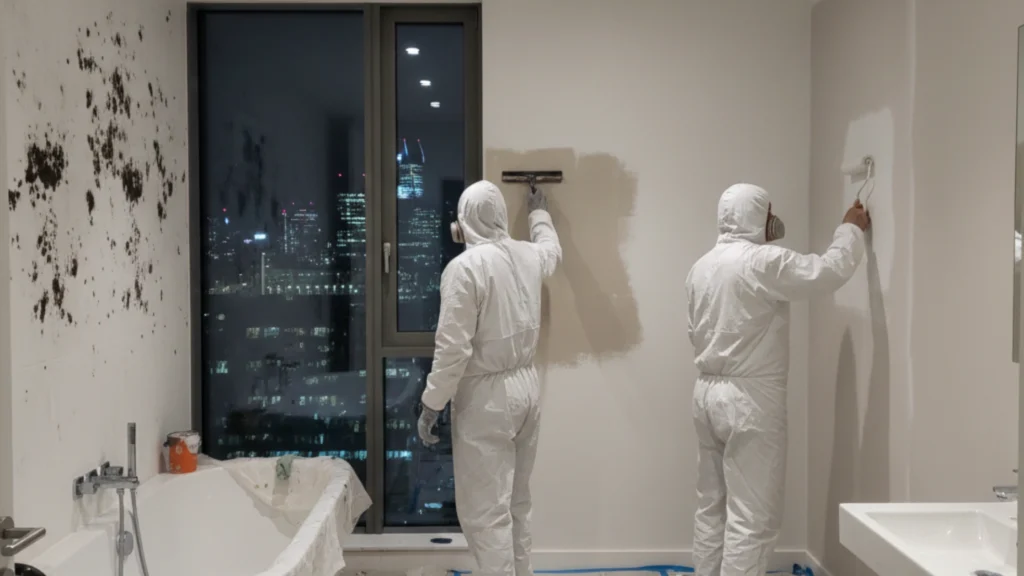
You moved into your Canary Wharf flat fourteen months ago. Everything was freshly painted. Bathroom included. Lovely clean white walls. Looked brand new. Previous owner had clearly done a good job before selling.
Six weeks after you moved in, a small black spot appeared in the corner where the ceiling meets the wall above the shower. You wiped it off with a damp cloth. It came back within a week. You wiped it again. It came back faster this time, and slightly bigger.
By month three there were black spots along the entire ceiling edge above the shower. Some had spread into patches the size of your hand. The previous owner’s lovely clean white paint was doing absolutely nothing to prevent mould growing on it because it was standard bathroom emulsion. The kind that looks fine when it goes on and does precisely nothing to actually prevent mould from establishing itself on the surface.
You ring a painter. They come out, look at the mould, tut sympathetically, and suggest painting over it with anti-mould paint. So they paint over it. Fresh white coat. Anti-mould paint from the same range as standard bathroom paint. Looks clean again. Problem solved.
Eight weeks later the mould is back. Same spots. Same patches. Same black growth along the ceiling edge where moisture collects after every shower. The anti-mould paint hasn’t prevented anything because nobody treated the existing mould before painting over it. You’ve painted fresh mould-resistant paint directly on top of active mould and given it a lovely sealed surface to continue growing behind.
Welcome to the expensive cycle of bathroom mould that thousands of Canary Wharf residents are trapped in without realising the painting is part of the problem rather than the solution. Bathroom painting isn’t about applying the right colour. It’s about understanding moisture, treating existing contamination properly, and creating conditions where mould genuinely cannot establish itself rather than simply covering up what’s already there.
I’ve spent ten years treating bathroom mould and painting bathrooms across Canary Wharf and Isle of Dogs. The cycle of mould appearing, getting painted over, reappearing, getting painted over again, is one of the most common and expensive maintenance issues in E14 flats. Breaking that cycle requires understanding what’s actually causing it rather than painting over symptoms repeatedly.
Why Bathroom Mould Keeps Coming Back
The single most important thing to understand about bathroom mould is that painting over it doesn’t kill it. It seals it. Which sounds helpful until you realise that sealed mould continues growing behind the paint layer, feeding on moisture that keeps arriving through wall and ceiling surfaces every single time someone takes a shower.
Mould is a living organism, not a stain. A water stain stays where it is until you remove it. Mould grows, spreads, and feeds continuously as long as moisture and a food source exist. Painting over active mould provides a food source, the paint itself, while moisture continues arriving through the wall surface behind it. You haven’t solved anything. You’ve given the mould better conditions to continue growing.
The moisture source is the actual problem. Mould appears in bathrooms because moisture condenses on cold surfaces after showering. Walls and ceilings stay cold, warm moist air from the shower hits them, water vapour condenses on the surface, and mould grows in that condensed moisture. This happens regardless of what paint is on the wall because condensation happens on the surface itself.
Anti-mould paint prevents mould establishing on a clean, properly treated surface. It does absolutely nothing to prevent mould continuing to grow on a surface that already has active mould present. The treatment and the prevention are completely different processes requiring completely different approaches.
The existing contamination goes deeper than visible black spots. Those patches on bathroom walls and ceilings represent the visible fruiting bodies of mould that has already penetrated into the surface underneath. Spores are present throughout the plaster, paint layers, and potentially the substrate itself in areas that have experienced repeated moisture exposure over years. Painting over visible mould without treating the contamination underneath means those spores continue growing and will re-emerge through any number of fresh paint coats given sufficient time and continued moisture.
The E14 Bathroom Challenge
Canary Wharf and Isle of Dogs bathrooms present specific moisture and mould challenges that intensify everything about bathroom painting.
The ventilation situation in managed buildings is often inadequate. Many E14 developments installed extraction fans during original construction that have degraded over years of use. Some have stopped working entirely. Some work but extract moisture too slowly to prevent condensation on bathroom surfaces after normal shower use. Bathroom painting that assumes adequate ventilation produces results that fail in bathrooms where ventilation is genuinely inadequate. Understanding actual ventilation before specifying products determines whether painting actually prevents mould or simply delays its return.
The building age creates specific substrate conditions. Older E14 developments have bathroom walls that have experienced years of moisture exposure, multiple paint layers, and potentially multiple mould cycles. Contamination in these surfaces goes significantly deeper than what’s visible on the surface. Treating only what you can see leaves active contamination underneath that resurfaces regardless of what goes on top.
Shared walls create moisture dynamics residents cannot control. Bathrooms in managed buildings sometimes share walls with neighbouring properties. Moisture from one bathroom affects the shared wall surface, creating condensation and mould on surfaces the resident can see but cannot control from their side. Understanding this prevents treating symptoms on your side while the actual moisture source remains entirely unaddressed next door.
A Real Project: The Blackwall Yard Bathroom Cycle
Two bed flat in Blackwall Yard. Beautiful property, well maintained throughout. But the bathroom had been in a mould cycle for three years. Previous owner painted over it before selling. New owner painted over it six months after moving in when it reappeared. Then again eight months after that. Each time mould came back faster and covered more surface area.
By the time the current owner called us, the ceiling above the shower had visible black mould patches covering roughly a third of the total area. The wall behind the shower had mould along the top two feet where moisture collected most heavily. Two layers of anti-mould paint had been applied over the previous two years without any meaningful effect on the underlying problem.
The assessment revealed exactly why the cycle kept repeating. The extraction fan had stopped working eighteen months earlier. Nobody noticed because mould was being painted over regularly enough that it never became dramatically visible. Without functioning extraction, every shower deposited moisture on bathroom surfaces with no way of dissipating before the next shower added more.
The existing mould contamination had penetrated through multiple paint layers into the plaster itself. Spores were present throughout the upper walls and entire ceiling. Painting over this contamination with anti-mould paint was essentially painting over a functioning mould farm. The product had nothing to work against because contamination was already established throughout the surface.
We addressed everything properly. First, the extraction fan situation was flagged to building management for repair. This was the single most critical element because no painting prevents mould when moisture has nowhere to go after every shower.
The entire affected area was treated with specialist mould killer that penetrates into plaster and substrate, killing contamination at depth rather than treating only the visible surface. This treatment needed proper dwell time before any painting proceeded.
After confirmed mould elimination throughout affected surfaces, specialist anti-mould primer was applied. This primer seals the treated surface and prevents residual spores migrating back through to the topcoat. Standard primer on previously mouldy surfaces provides zero protection against spore migration.
Anti-mould topcoat was applied over the specialist primer. Two coats. Proper coverage throughout. The entire system, killer, primer, topcoat, working together as an integrated solution rather than simply applying anti-mould paint over existing contamination and hoping for the best.
The extraction fan was repaired two weeks after our treatment. The bathroom has remained mould free for eight months since. The cycle repeating every few months for three years has finally broken because actual causes were addressed rather than symptoms being painted over repeatedly.
What Proper Bathroom Mould Treatment Actually Requires
Let me be specific about what genuinely breaking the mould cycle involves beyond simply applying anti-mould paint.
Mould killer treatment before any painting starts. Active mould contamination must be killed and eliminated before paint goes anywhere near the surface. Specialist mould killer penetrates into plaster and substrate killing contamination at depth. Standard bleach on the surface kills visible mould but leaves spores in the substrate untouched and ready to regrow. Painters who skip this step and apply anti-mould paint directly over active mould are guaranteeing the cycle continues.
Specialist anti-mould primer after treatment. Anti-mould primer seals treated surfaces and prevents spore migration from substrate back through to the topcoat. Standard primer provides zero protection against this migration. Using standard primer after mould treatment means spores already present in the plaster can migrate through to fresh paint and establish new growth.
Ventilation assessment before anything else. If bathroom extraction isn’t working properly, no amount of painting prevents mould. Moisture with nowhere to go after showering will condense on bathroom surfaces regardless of paint applied. Identifying ventilation problems before painting prevents expensive disappointment of genuinely good painting failing because the underlying moisture problem wasn’t addressed.
The Silicone Situation Nobody Discusses
Deteriorating silicone sealant around baths, showers, and sinks allows moisture penetrating behind fixtures and into wall surfaces where it feeds mould growth invisible from the front. Replacing deteriorating silicone alongside bathroom painting prevents moisture ingress that anti-mould paint on visible surfaces cannot possibly address.
Silicone deteriorates through age, cleaning product exposure, and normal bathroom use. Cracked, discoloured, or peeling silicone is no longer functioning as a moisture barrier regardless of how good it looked originally. Checking silicone condition alongside any bathroom painting project prevents moisture entering surfaces through routes paint simply cannot reach.
What to Demand From Bathroom Painters
If your E14 bathroom has mould problems, these specifics actually break the cycle rather than simply restarting it.
Mould treatment before any painting starts. They should treat existing mould contamination with specialist mould killer before paint goes on. If they suggest applying anti-mould paint directly over visible mould without treatment first, the cycle will simply continue repeating exactly as it has been.
Ventilation assessment included automatically. They should check your extraction fan works properly before specifying anything. If extraction is inadequate, they should flag this before painting rather than discovering it when mould returns through fresh paint within months.
Full integrated product system specified. Mould killer, specialist anti-mould primer, and anti-mould topcoat working as a complete system. If they’re proposing simply applying anti-mould paint without the treatment and primer stages, they’re painting over the problem rather than solving it.
Silicone condition checked and replaced where needed. Deteriorating silicone around fixtures allows moisture behind surfaces where paint cannot reach. If they’re not checking silicone condition alongside bathroom painting, moisture ingress points remain active regardless of how good the paint system actually is.
Actually Break The Cycle
Bathroom mould in E14 flats is one of the most persistent and expensive maintenance problems residents face. The cycle of mould appearing, getting painted over, reappearing, and getting painted over again repeats indefinitely until someone treats the actual contamination, addresses the moisture source, and applies a properly integrated system designed to prevent establishment on genuinely clean surfaces.
We specialise in bathroom mould treatment and anti-mould painting across Canary Wharf and Isle of Dogs. We treat contamination properly before painting anything. We check ventilation before specifying products. And we apply integrated systems that actually prevent mould rather than covering it up until next time.
Call for quote now: 07507 226422 Email: hello@havenedge.co.uk Website: www.havenedge.co.uk