
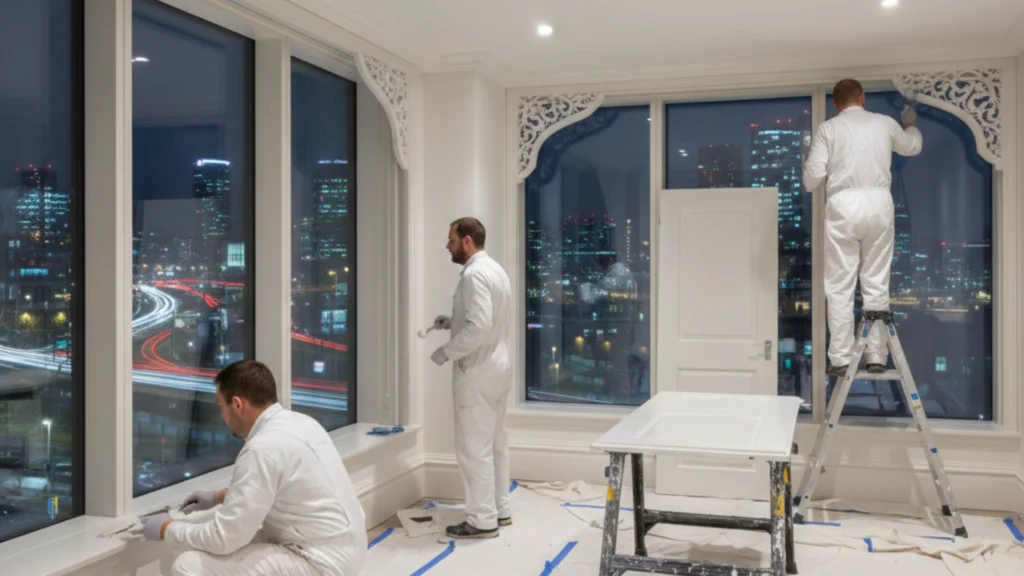
You’ve just had your entire Canary Wharf flat repainted. Walls look stunning. Fresh, clean, exactly the colour you chose. The living room genuinely feels like a completely different space to what it was three weeks ago. You’re genuinely pleased with how it’s turned out.
Then you actually look at the skirting boards.
The painter painted them. Obviously they painted them. They’re white. They were white before. They’re white now. But something’s wrong. The finish looks slightly different along the top edge where the skirting meets the wall, a subtle line where the wall colour meets the woodwork that isn’t quite sharp enough. There’s a visible brush stroke running along the front face that catches the light every time you walk past. The door frames have the same issue. Brush marks running vertically along the flat faces that were invisible when the paint was wet but became obvious as it dried and the sheen settled.
And the worst bit. The bit that makes you genuinely annoyed rather than just slightly disappointed. The paint on the skirting boards is already chipping. A tiny chip on the corner of the hallway skirting where your vacuum cleaner caught it yesterday. Another chip along the bottom of the living room skirting where your son kicked a toy against it this morning. The paint is peeling away from the wood surface in thin flakes rather than holding firm.
The walls look gorgeous. The woodwork looks amateur. And because woodwork runs throughout every single room in your flat, connecting every space visually, the woodwork sets the tone for the entire property more than the walls actually do. A flat with beautiful walls and shoddy woodwork looks like someone painted the easy bits and rushed the difficult ones.
Welcome to the expensive disappointment of hiring painters who treat woodwork as an afterthought they knock out after finishing the walls. Skirting boards, door frames, window frames, architrave, and trim aren’t secondary surfaces that get whatever attention remains after the walls are done. They’re the architectural detail that defines how your flat actually looks and feels, and they require specialist technique, specialist products, and genuine understanding of wood as a material rather than simply another surface to cover.
I’ve spent ten years painting woodwork across Canary Wharf and Isle of Dogs. The number of painters who treat skirting and doors as something they bash out quickly before leaving is genuinely frustrating because woodwork done properly elevates an entire flat while woodwork done badly drags everything else down regardless of how good the walls look.
Why Woodwork Painting Is Fundamentally Different To Wall Painting
Walls and woodwork both get painted. Both end up covered in emulsion or similar products. But wood as a material behaves completely differently to plaster under paint, requires completely different preparation, and demands completely different application technique to produce results that actually last and actually look professional.
Wood moves. Plaster doesn’t. Wood expands and contracts with temperature and humidity changes throughout the year. In winter when heating runs constantly, wood dries and shrinks slightly. In summer when humidity rises, wood absorbs moisture and expands. This movement is continuous and perpetual throughout the life of the property.
Paint on wood must accommodate this movement without cracking, chipping, or peeling as the wood underneath shifts beneath it. Paint systems designed for wood understand this movement and remain flexible enough to cope with it indefinitely. Standard wall emulsion applied to wood becomes rigid as it cures and cracks along grain lines and edges as the wood moves underneath it. This is precisely why woodwork painted with inappropriate products chips and peels while the walls beside it remain perfectly intact.
The existing surface condition on woodwork varies enormously. New woodwork has bare wood that needs specific priming before topcoat. Previously painted woodwork has layers of old paint, possibly multiple layers from previous decoration cycles, that need assessment and treatment before new paint goes on. Woodwork with glossy existing finish needs specific preparation to create grip for new paint. Woodwork with damaged existing paint needs repair before new paint can produce a smooth finish.
Wall painters assess walls quickly because plaster surfaces are relatively uniform. Woodwork requires individual assessment of each piece because every door, every section of skirting, every piece of architrave might be in different condition requiring different treatment.
The finish standard on woodwork is judged far more critically than walls. People don’t scrutinise walls closely unless something is obviously wrong. People look directly at skirting boards, door frames, and trim constantly because these surfaces sit at eye level, at hand level, and at the level where furniture meets the floor. Every brush mark, every drip, every imprecision in cutting in where woodwork meets walls is visible to anyone looking at the flat.
Woodwork painting demands a level of finish precision that wall painting simply never requires because the scrutiny level is dramatically higher.
The E14 Woodwork Challenge
Canary Wharf and Isle of Dogs flats present specific woodwork painting challenges that intensify every general difficulty.
The woodwork condition in older E14 developments tells a story. Properties that have changed hands multiple times have woodwork painted over repeatedly without proper preparation between cycles. Layer upon layer of paint builds up, obscuring the original wood profile, creating drips and runs that have dried into permanent ridges along skirting boards and door frames. Painting over this accumulated history without addressing it produces results that look lumpy and amateur regardless of topcoat quality.
Professional woodwork painters assess this history and treat it appropriately. Painters who simply apply fresh paint over decades of accumulated layers produce results that look worse than what was there before because the underlying texture shows through every coat applied on top.
The MDF versus timber distinction matters enormously. Many E14 developments installed MDF skirting and architrave during construction because it’s cheaper than timber and paints beautifully when done correctly. But MDF absorbs paint differently to timber, particularly along cut edges where the fibrous material soaks up paint greedily and produces a different finish to the flat faces. Painters who don’t understand this distinction treat MDF edges the same as timber faces and produce uneven absorption that’s visible once the paint dries.
The high ceilings in conversion properties create woodwork at genuinely difficult heights. Warehouse conversions across E14 frequently have skirting boards at standard height but door frames, window frames, and architrave running up to ceiling heights of five metres or more. Painting woodwork at these heights requires proper access equipment and genuinely different technique to painting woodwork at normal residential heights.
A Real Project: The Poplar Street Woodwork Disappointment
Homeowner in a period property near Poplar Street had just completed a full repaint of their ground floor. Gorgeous colours throughout. Warm sage in the living room, soft white in the kitchen, beautiful dusty blue in the hallway. The walls looked genuinely stunning.
The woodwork looked terrible. Not dramatically terrible. Just consistently amateur throughout every single room, enough that walking through the ground floor felt like walking through a flat where someone had painted the walls beautifully and then handed the woodwork to someone who didn’t particularly care about getting it right.
They hired a painter specifically to redo all the woodwork throughout the ground floor. Talented painter with impressive wall finishes. But had always treated woodwork as the quick finish at the end of a wall painting job rather than specialist work requiring its own preparation and technique.
The preparation was completely inadequate for the existing woodwork condition. The skirting boards throughout the ground floor had accumulated roughly six layers of paint over the property’s history. Previous owners had painted over previous paint without sanding, creating a built-up surface with visible drips and runs along the top edges that had dried into permanent ridges decades ago.
The painter cleaned the woodwork with a damp cloth, sanded very lightly with fine sandpaper, and applied fresh gloss directly over the existing surface. The underlying ridges and built-up layers showed through the fresh paint as subtle texture variations visible along every skirting board throughout the ground floor. The light sanding hadn’t created anything close to sufficient grip on the glossy existing surface for new paint to bond properly.
The product selection was wrong for the existing condition. Standard gloss emulsion was specified. Reasonable for woodwork in good condition with proper preparation underneath. Completely inadequate for woodwork with six layers of old paint, glossy existing finish, and accumulated surface texture that needed specialist treatment before any new paint would adhere or look smooth.
The brush marks were visible throughout. Painting skirting boards and door frames with a brush requires specific technique that produces invisible brush marks when done correctly and obvious ones when done incorrectly. The technique involves applying paint in long, consistent strokes with the grain of the wood rather than short dabbing strokes across it. The painter had used short strokes that left visible brush marks along every flat face of every piece of woodwork throughout the ground floor.
The chips appeared within days of completion. Fresh gloss paint applied over glossy existing surface without proper bonding preparation had essentially nothing meaningful to grip. The first physical contact, a vacuum cleaner, a child’s shoe, a piece of furniture nudged slightly, produced chips that revealed the layers underneath because the fresh paint had never bonded properly to what was beneath it.
We stripped and prepared everything properly. Thorough sanding sequence that addressed the built-up layers, created genuine mechanical grip on the glossy existing surface, and smoothed the accumulated ridges and drips to genuinely flat condition before any new paint went anywhere near the woodwork.
Specialist wood primer applied after preparation, specifically formulated to bond to previously painted and glossy wood surfaces and to provide the foundation new topcoat needs to adhere permanently. Standard primer on glossy previously painted woodwork provides essentially zero meaningful grip.
Specialist woodwork topcoat applied in long, consistent strokes with the grain, producing genuinely smooth finish without visible brush marks. Two full coats with proper flash time between them, allowing each coat to reach appropriate hardness before the next was applied.
The finished woodwork looked genuinely new throughout the entire ground floor. Sharp, smooth, professional finish that made the already gorgeous walls look even better because the woodwork finally matched their quality. The chips that had appeared within days of the previous attempt hadn’t reappeared in the three months since our work was completed.
What Professional Woodwork Painting Actually Requires
Let me be specific about what genuinely understanding woodwork painting means in practice.
Individual assessment of every piece of woodwork before painting begins. Not a quick visual scan of the room. Actual assessment of each skirting board, each door frame, each piece of architrave. What condition is the existing paint in? How many layers have accumulated? Is the surface genuinely smooth or has build-up created texture? Is the existing finish glossy requiring specific preparation for grip? Each piece might need different treatment and assuming they’re all the same produces inconsistent results.
Appropriate preparation for the specific existing condition. Built-up paint layers need proper sanding sequence to flatten and create grip. Glossy existing surfaces need specific preparation that creates mechanical grip without requiring complete stripping. Damaged areas need filling and sanding to genuinely flush condition before any new paint goes on. Each situation requires different preparation and applying one method to everything produces poor results on surfaces that needed different treatment.
Wood-specific primer after preparation. Standard wall primer on woodwork provides inadequate grip, particularly on previously painted or glossy surfaces. Wood-specific primer bonds to wood and previously painted wood surfaces properly and provides the foundation topcoat needs to adhere permanently and withstand the physical contact woodwork receives constantly throughout normal flat use.
Specialist woodwork topcoat, not standard emulsion. Woodwork paint systems are formulated to remain flexible enough to accommodate wood movement without cracking or chipping. They cure harder than wall emulsion to withstand physical contact. They produce smoother finishes with appropriate sheen levels. Standard wall emulsion on woodwork looks adequate initially and deteriorates rapidly under normal use because it simply isn’t formulated for the demands woodwork faces.
Long stroke application technique with the grain. Brush marks on woodwork are visible permanently once the paint dries because the flat surfaces and critical viewing angles mean every stroke is scrutinised. Long, consistent strokes applied with the wood grain produce smooth, invisible brush marks. Short dabbing strokes produce visible marks regardless of paint quality or preparation beneath them.
The Skirting Board as The Room’s Frame
Skirting boards run continuously around every single room in your flat. They’re the architectural frame that defines where walls end and floors begin. Getting them right elevates everything else in the room. Getting them wrong drags everything else down regardless of how good the walls and floors actually look.
The visual weight is significant. Skirting boards occupy a continuous horizontal line at the base of every wall in every room. This continuous presence means their appearance contributes to how the room feels more than most people consciously realise until the skirting looks genuinely good or genuinely bad.
The junction between skirting and walls defines the quality impression. Where skirting meets walls is where cutting in precision matters most in any flat. A crisp, sharp line where white woodwork meets coloured walls communicates professional finish. A fuzzy, uneven line communicates amateur work regardless of how good the individual surfaces look in isolation.
The physical contact level is highest here. Skirting boards get knocked by furniture, kicked by feet, bumped by vacuum cleaners, and touched constantly during normal flat use. The paint finish on skirting needs to withstand this contact for years without chipping, peeling, or showing wear. Products and preparation that achieve this on skirting boards will achieve it on doors and frames too. Products that can’t handle skirting board contact will fail on everything else as well.
What to Demand From Woodwork Painters
If your E14 flat needs woodwork painted properly, these specifics protect your investment and ensure the result genuinely lasts.
Individual woodwork assessment before any painting starts. They should examine each piece of woodwork individually before proposing anything. If they’re planning to treat all woodwork identically without assessment, surfaces in different conditions will produce different results regardless of technique applied.
Wood-specific primer confirmed in the specification. Not standard wall primer. Wood-specific primer formulated for previously painted and glossy wood surfaces. If they’re proposing the same primer for woodwork as for walls, the grip on woodwork won’t be adequate for the physical contact it receives.
Specialist woodwork topcoat, not wall emulsion. The product matters enormously on woodwork because wood moves, woodwork gets touched constantly, and the finish standard is judged far more critically than walls. If they’re proposing standard emulsion for woodwork, it will chip and deteriorate significantly faster than specialist woodwork products would.
Brush mark prevention technique confirmed. Ask specifically how they prevent visible brush marks on flat woodwork faces. If they can’t explain their technique clearly, the brush marks will be visible once the paint dries and the flat surfaces catch light from every angle.
Get Your Woodwork Done Properly
Woodwork painting done correctly defines how your entire flat looks and feels. Done badly, it drags down everything else regardless of how good the walls, floors, and everything else in the property actually are.
We specialise in woodwork painting across Canary Wharf and Isle of Dogs. We assess each piece individually. We prepare surfaces specifically for what they actually need. We use wood-specific products that withstand physical contact and wood movement permanently. And we produce finishes smooth enough that brush marks simply don’t exist.
Call for quote now: 07507 226422 Email: hello@havenedge.co.uk Website: www.havenedge.co.uk