
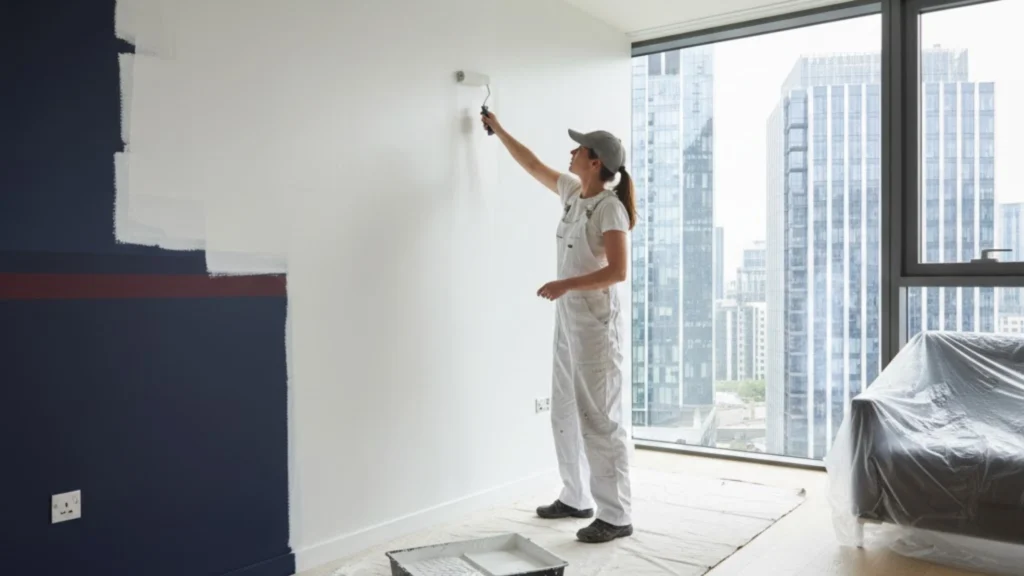
You bought your Isle of Dogs flat eight months ago. Previous owner had decorated throughout in their personal taste. Bold colours everywhere. Navy blue feature wall in the living room. Deep burgundy in the bedroom. Charcoal grey in the hallway. Distinctive. Memorable. Absolutely not your style.
You want fresh, light, neutral walls throughout. Clean white that makes the space feel bigger and brighter. Simple enough. Paint over the dark colours with white. Two coats should cover it. Standard job.
Your painter agrees. Arrives Monday with white emulsion. Applies first coat over the navy feature wall. The dark blue shows through the wet white paint but that’s normal. First coat always looks patchy. Second coat will cover it properly.
Second coat goes on. Dries. The navy is still visible through the white. Not dramatically obvious but clearly present as a blue-grey shadow underlying the white topcoat. The painter applies a third coat. You’re now three coats deep. The navy is still showing through. Fainter than before but undeniably visible as uneven shadowing across the wall that makes the white look dirty and inconsistent.
The burgundy bedroom is worse. Four coats of white applied over deep red. The wall still has a visible pink tone underneath the white that makes the entire room look like someone spilled diluted rosé across it and called it decorating.
You’ve spent a week having your flat painted. Used substantially more paint than quoted because covering dark colours took multiple extra coats nobody anticipated. And the walls still don’t look genuinely white. They look like white paint struggling to hide dark paint underneath, which is exactly what they are.
Welcome to the expensive nightmare of trying to cover dark colours with light colours using standard approach and hoping multiple topcoats will eventually hide what’s underneath. Dark paint doesn’t become invisible under white topcoat simply by applying more layers. The pigment particles in dark paint continue affecting colour perception through multiple coats of lighter paint above them because light penetrates through paint layers and reflects back from underlying colours beneath.
I’ve spent ten years covering dark paint with light colours across Canary Wharf and Isle of Dogs. The number of flats where residents or painters have applied five or six coats of white over dark colours and still see the underlying tone showing through is genuinely frustrating because professional dark colour coverage requires specific products and techniques that standard painting simply doesn’t employ.
Why Does Dark Paint Keep Showing Through Light Paint No Matter How Many Coats You Apply?
The relationship between underlying colour and topcoat isn’t simple layering where enough coats eventually create opacity. It’s optical physics where light behaviour determines what you actually see.
Paint is translucent rather than completely opaque. Light passes through paint layers, reflects off the substrate or underlying paint beneath, and travels back through the paint layers to your eyes. What you perceive as the wall colour is actually light that has travelled through the topcoat, reflected off whatever is underneath, and returned through the topcoat carrying colour information from every layer it passed through.
Dark colours have high pigment concentration and strong tinting strength. Navy blue, burgundy, charcoal, these colours contain substantial pigment loads that continue influencing light reflection even when covered by lighter colours above them. Light passing through white topcoat hits the dark layer underneath, absorbs some wavelengths and reflects others, and returns through the white carrying colour information from the dark paint below.
Multiple coats of light paint over dark reduce but don’t eliminate this effect. Each additional white coat increases the total paint thickness, reducing how much light reaches the dark layer underneath. But unless the white paint layer becomes genuinely thick, some light still penetrates to the dark paint and returns carrying its colour information. This is why dark colours show through as shadowing or undertones rather than disappearing completely.
The shadowing appears uneven because paint application is never perfectly uniform. Slight variations in coat thickness, areas where roller coverage overlapped versus areas with single pass coverage, these minor variations create thickness differences that allow more or less light to reach the dark layer underneath. The result is uneven shadowing where some sections show more underlying colour than others despite identical topcoat colour throughout.
Standard emulsion simply cannot build sufficient thickness in reasonable coat numbers to completely block light reaching dark paint underneath. Professional dark colour coverage requires specialist products designed specifically to block underlying colours rather than hoping multiple standard topcoats will eventually hide them.
What’s The Difference Between Tinted Primer And Standard Primer For Dark Coverage?
This distinction determines whether covering dark colours takes two coats or six coats and whether the result actually looks genuinely white or perpetually shadowed.
Standard primer is white or off white designed to seal surfaces and provide uniform base for topcoat. Standard primer applied over dark colours provides some coverage but the white primer itself is translucent enough that dark colours show through it substantially. Two coats of white topcoat over standard white primer on dark paint still shows underlying colour because the primer hasn’t blocked the dark paint adequately.
Tinted primer is grey primer specifically formulated to block strong underlying colours. The grey tone is created by high pigment loading that provides superior hiding power compared to white primer. Tinted primer applied over dark colours creates a neutral grey barrier that blocks most light from reaching the dark paint underneath. Two coats of white topcoat over grey tinted primer on dark paint produces genuinely white results because the primer has effectively blocked the underlying colour.
The grey tinting seems counterintuitive when the goal is white walls but the physics supports it completely. Grey primer blocks more light than white primer because grey contains more total pigment. Blocking light from reaching the dark layer underneath is more important than the primer colour itself because the topcoat determines final appearance while the primer determines whether underlying colours affect that final appearance.
Specialist stain blocking primers go further with even higher pigment loading and sealing properties designed to block not just colour but also stains, tannins, and contamination from showing through topcoat. These primers cost more than standard primers but require fewer total coats to achieve genuine coverage over problematic underlying colours.
The difference between standard approach and professional approach is two coats over tinted primer producing genuinely white walls versus five or six coats over standard primer producing white-ish walls that still show undertones from dark paint underneath.
A Real Project: The Crossharbour Dark Coverage Disaster
Two bed flat near Crossharbour. Previous owner had decorated boldly. Teal in the living room. Plum in the master bedroom. Burnt orange in the second bedroom. The new owner wanted neutral light grey throughout to create cohesive contemporary feel.
They hired a decorator who quoted for standard redecoration. Two coats throughout. Straightforward job. The decorator didn’t mention anything about the dark colours requiring special treatment. Just standard white primer, standard grey topcoat over everything.
The teal living room took five coats to achieve acceptable coverage. First coat of primer barely touched the teal intensity. First topcoat over primer still showed substantial teal undertone. Second topcoat reduced it further. Third topcoat reduced it more. Fourth topcoat finally produced something approaching the intended light grey but with noticeable colour variation across the wall where some sections retained more teal undertone than others.
The plum bedroom never achieved genuinely consistent coverage. Six coats total. The wall still showed pink undertones in sections where the plum underneath was particularly intense. The intended light grey looked different from the living room’s light grey despite being identical paint because the underlying plum was affecting colour perception differently than the underlying teal.
The paint consumption exceeded the quote by roughly three times. What should have required perhaps fifteen litres for the entire flat used over forty litres because covering dark colours with inadequate products required multiple coats nobody had anticipated. The additional paint cost, additional labour time, and extended disruption created genuine friction between decorator and client.
We stripped everything back and redid it properly. High coverage stain blocking primer throughout all previously dark walls. Single coat of grey tinted primer creating uniform neutral base that completely blocked underlying colours. Two coats of the intended light grey over the blocking primer. Total of three coats produced genuinely consistent colour throughout the entire flat.
The difference was dramatic. Walls that had required six coats and still showed undertones were now genuinely consistent after three coats using appropriate products. The colour matched between rooms because underlying colours weren’t affecting perception. The finish looked professional because it was executed using professional products designed specifically for covering strong underlying colours.
What Does Professional Dark Paint Coverage Actually Require?
Proper coverage of dark colours with light colours requires specific products and application sequence rather than hoping multiple standard coats eventually work.
Assessment of underlying colour intensity determines primer specification. Moderately dark colours like mid-tone blues or greens might be adequately covered with standard tinted primer. Genuinely intense colours like navy, burgundy, or black require specialist stain blocking primer with maximum hiding power. Assuming all dark colours need identical treatment produces inconsistent results because intensity varies dramatically between different dark colours.
Appropriate primer selection before any topcoat is applied. Grey tinted primer for moderate coverage requirements. Specialist stain blocking primer for intense dark colours. White standard primer is completely inadequate for covering dark colours and applying it over dark paint wastes money and time because it simply doesn’t block underlying colour sufficiently.
Single primer coat allowed to cure properly before topcoat application. Primer needs time to cure and develop full hiding properties. Applying topcoat over wet or incompletely cured primer reduces the primer’s effectiveness at blocking underlying colour. Professional coverage means patience between coats rather than rushing to get topcoat on before primer has fully cured.
Two topcoats over properly specified and cured primer. Once the primer has blocked underlying colour effectively, two topcoats produce genuinely consistent final colour. The topcoats aren’t fighting to hide dark paint underneath because the primer has already done that job. The topcoats are simply building final colour and finish over neutral base.
What Should E14 Residents Demand When Covering Dark Colours?
Underlying colour assessment confirmed before any quote is provided. They should inspect current wall colours and confirm which primer type will be used before quoting. If they’re quoting without discussing primer specification for dark coverage, they’re guessing at coat numbers and the job will likely overrun.
Tinted or stain blocking primer specified explicitly for dark walls. Not standard white primer. If their quote specifies standard primer for covering navy or burgundy walls, they’re proposing inadequate products that will require multiple extra topcoats to achieve questionable coverage.
Coat numbers confirmed as primer plus two topcoats maximum. Professional dark coverage is three coats total using appropriate primer. If they’re quoting four or five coats, they’re planning to use inadequate primer and compensate with extra topcoats which costs more and produces inferior results.
Sample testing if changing to significantly lighter colour. Testing how the proposed primer and topcoat actually cover your specific dark colour before committing to entire rooms prevents discovering halfway through that coverage isn’t working as anticipated.
Get Your Dark Colours Actually Covered
Covering dark paint with light colours requires understanding that multiple coats of standard products produce inferior results compared to fewer coats of appropriate specialist products. Dark colours don’t disappear under white paint through persistence alone. They’re blocked by primers designed specifically to prevent underlying colours affecting topcoat appearance.
We specialise in covering dark colours across Canary Wharf and Isle of Dogs. We assess underlying colour intensity properly. We specify tinted or stain blocking primers appropriate for what we’re covering. We cure primers properly before topcoat. And we produce genuinely consistent light colours in three coats rather than questionable coverage in six.
Call for quote now: 07507 226422 Email: hello@havenedge.co.uk Website: www.havenedge.co.uk
CSCS certified, fully insured, experienced with dark colour coverage across E14. Your walls deserve proper primer specification rather than hoping multiple standard topcoats eventually hide what’s underneath.