
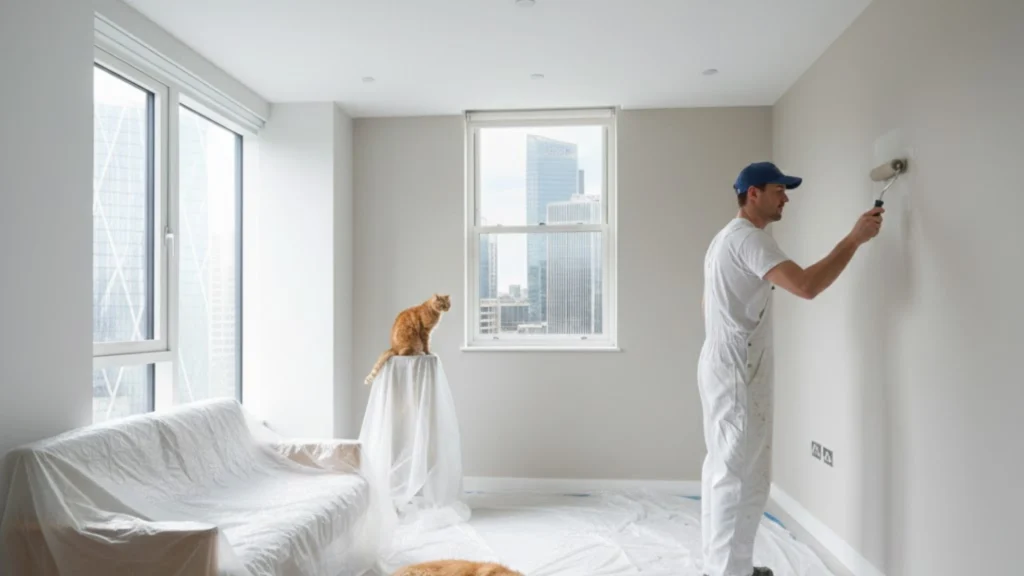
You had your Isle of Dogs flat repainted last month. Fresh white throughout. Beautiful even coverage. The painter did excellent work. Clean, professional, completed on schedule. You took your dog to your parents’ house for the day while painting happened. Brought him home that evening once the painter had finished and left.
Your cocker spaniel seemed fine initially. Slightly subdued but you attributed that to being away from home for the day. He ate his dinner normally. Settled down for the evening. Everything appeared fine.
The next morning he wouldn’t eat breakfast. Unusual for a dog who normally inhales his food within seconds. He seemed lethargic. Sleeping more than normal. You put it down to being unsettled by the disruption yesterday. Give him another day to adjust.
Day three he vomited twice. Started panting heavily despite not exercising. His eyes looked slightly irritated. You booked a vet appointment. The vet examined him thoroughly. Couldn’t find anything obviously wrong. Suggested it might be stress from changes in the home environment. Prescribed anti-nausea medication. Advised monitoring for a few more days.
Day five you finally connected the symptoms to the painting. The flat still smelled faintly of fresh paint. The windows had been closed overnight because of the cold. Your dog was breathing concentrated paint fumes for hours while sleeping. The volatile organic compounds in standard emulsion were making him genuinely ill and nobody, including the vet initially, had considered paint exposure as the cause.
Welcome to the expensive and distressing reality of having pets in flats painted with standard high VOC products without adequate ventilation or consideration for animal sensitivity to chemical exposure. Dogs and cats have significantly different physiology to humans. Their smaller body size, faster metabolism, and different respiratory systems make them substantially more vulnerable to airborne chemical exposure than adult humans.
I’ve spent ten years painting flats across Canary Wharf and Isle of Dogs where residents have pets. The number of owners who don’t realise standard painting products can make their animals genuinely ill is alarming because most painters never discuss VOC levels, ventilation requirements, or pet-safe product alternatives unless specifically asked.
Why Are Standard Paints More Dangerous For Pets Than Humans?
The vulnerability difference between pets and humans isn’t marginal. It’s substantial enough that exposure levels safe for adults can make animals genuinely ill.
Body size affects chemical exposure impact dramatically. A human adult weighing seventy kilograms absorbs and processes chemicals completely differently to a cat weighing four kilograms or a small dog weighing eight kilograms. The same concentration of airborne VOCs produces seventeen times higher exposure per kilogram of body weight in a four kilogram cat compared to a seventy kilogram human. This concentration difference means safe human exposure levels become toxic pet exposure levels in identical environments.
Respiratory rate amplifies exposure further. Dogs breathe roughly thirty to forty times per minute at rest compared to humans breathing twelve to twenty times per minute. Cats breathe twenty to thirty times per minute. This faster breathing rate means pets inhale substantially more air per minute relative to body size than humans do, increasing VOC intake proportionally.
Metabolism differences affect how chemicals are processed. Pet livers process certain chemical compounds less efficiently than human livers, meaning chemicals that humans metabolise and eliminate relatively quickly accumulate in pet systems for longer periods. This slower elimination extends exposure duration even after VOC levels in the air have dropped to levels humans no longer notice.
Ground level living concentrates exposure for pets. Paint fumes are heavier than air and settle toward floor level where pets spend their entire lives. Dogs and cats sleeping on floors breathe concentrated fume layers that humans standing or sitting above don’t experience. Fresh paint overnight with closed windows creates floor-level VOC concentrations substantially higher than concentrations at human head height.
Grooming behaviour creates ingestion exposure beyond inhalation. Cats groom themselves constantly, licking their fur repeatedly throughout the day. VOC particles settling on fur get ingested during grooming. Dogs lick their paws after walking across freshly painted skirting boards or touching walls. This ingestion exposure adds to inhalation exposure, creating combined exposure levels standard products weren’t designed to be safe for.
What’s The Difference Between Low VOC And Zero VOC Paints For Pet Safety?
The terminology matters because the difference between low VOC and zero VOC determines whether pets can safely remain in the property during painting or need evacuation for extended periods.
Standard emulsion contains volatile organic compounds ranging from thirty to two hundred and fifty grams per litre depending on formulation. These VOCs evaporate during drying, releasing chemical fumes into the air throughout the drying and curing process. The fumes continue off-gassing for days to weeks after application at decreasing intensity. Pets exposed to these fume levels show symptoms ranging from respiratory irritation to gastrointestinal upset to neurological effects depending on exposure intensity and duration.
Low VOC paint contains reduced but not eliminated volatile organic compounds, typically under fifty grams per litre. This reduction substantially decreases fume intensity but doesn’t eliminate chemical exposure. Low VOC products still require ventilation during and after application and still present exposure concerns for sensitive pets particularly in small flats where air volume is limited and fume concentration builds quickly.
Zero VOC paint contains less than five grams per litre of volatile organic compounds. Some formulations genuinely contain zero measurable VOCs. These products produce minimal odour during application and drying, off-gas negligible fumes, and present substantially reduced exposure risk to pets remaining in the property during painting.
The safety difference is whether pets need evacuation or can remain home during work. Standard and low VOC products require pet evacuation for the painting day plus at least twenty four to seventy two hours afterward with continuous ventilation throughout. Zero VOC products allow pets to remain in other rooms during application and return to painted rooms within hours rather than days.
A Real Project: The Canary Wharf Cat Emergency
One bed flat near Canary Wharf station. Owner had two Persian cats. Beautiful long-haired animals that lived entirely indoors. The flat needed complete redecoration. Fresh magnolia throughout. Standard job.
The owner asked their painter whether the cats needed to leave during painting. The painter said taking them elsewhere for the day would be sensible but they could come home that evening once painting was finished. The owner arranged for the cats to stay with a friend for the day. Brought them home at 7pm after the painter had left and the flat had been ventilated for several hours.
The first cat started showing symptoms within twelve hours. Refusing food. Excessive drooling. Laboured breathing. The owner rushed her to the emergency vet at 3am. The vet identified chemical exposure as likely cause based on symptoms and recent painting. Administered treatment. Kept the cat under observation overnight. She recovered but the vet bill was substantial.
The second cat developed similar symptoms by day two. Same pattern. Refusing food, drooling, breathing difficulty. Second emergency vet visit. Second substantial bill. The vet explicitly advised removing the cats from the property until all paint fumes had completely dissipated, which could take two weeks with standard products.
The owner contacted us asking whether the flat could be repainted with safer products. The existing fresh magnolia needed covering with genuinely pet-safe zero VOC paint because the cats couldn’t safely live in the flat for potentially weeks while standard paint continued off-gassing.
We repainted the entire flat with certified zero VOC products. Complete coverage over the recently applied standard paint using specialist pet-safe formulations. The zero VOC products produced essentially no odour during application. The cats remained with their temporary carer during the painting day as precaution but could return the following morning safely.
The cats showed no symptoms after returning to the flat painted with zero VOC products. No respiratory issues. No gastrointestinal upset. Normal behaviour immediately upon return. The difference between standard products that made both cats genuinely ill and zero VOC products that produced no adverse effects was dramatic and expensive proof that product selection matters enormously for pet safety.
What Does Pet-Friendly Painting Actually Require?
Professional pet-safe painting involves specific product choices and working methods that standard painting doesn’t typically employ.
Zero VOC paint specification throughout the property. Not low VOC. Genuinely zero or near-zero VOC formulations certified for minimal off-gassing. The product specification matters more for pet safety than application skill because even perfectly applied standard paint makes pets ill through chemical exposure.
Ventilation planning that accounts for pet return timing. When can pets safely return to painted areas? With standard products, days to weeks. With low VOC products, twenty four to seventy two hours. With zero VOC products, same day or next morning depending on application area and ventilation achieved.
Floor level contamination avoidance throughout painting. Protecting floors from paint drips and overspray prevents pets walking through or lying on contaminated surfaces. Drop sheets throughout work areas. Careful masking of skirting boards. Immediate cleanup of any spills or drips before they dry.
Pet-safe cleanup products after painting completion. Standard white spirit or chemical cleaners leave residues pets might contact or ingest through grooming. Water-based cleanup with pet-safe detergents where necessary prevents secondary exposure from cleaning product residues.
What Should E14 Pet Owners Demand From Painters?
Zero VOC product specification confirmed explicitly in writing. Not low VOC. Zero VOC throughout all painted areas. If they’re proposing standard or low VOC products for a property with pets, they’re not prioritising pet safety appropriately.
Pet safety discussion before work begins. They should ask about pets, discuss evacuation timing, and explain ventilation requirements for the products they’re using. If they don’t mention pets at all during planning, they’re not considering animal safety as part of their approach.
Certification evidence for VOC levels in proposed products. Zero VOC claims should be verified through product specifications showing actual VOC content measurements. If they can’t provide documentation of VOC levels, the zero VOC claim might be marketing rather than measurable reality.
Return timing confirmed based on actual product off-gassing rather than generic advice. When specifically can pets return safely to painted areas? If they can’t answer based on the products they’re using, they’re guessing rather than specifying based on pet safety requirements.
Get Your Flat Painted Without Making Your Pets Ill
Pet-friendly painting requires understanding that animals experience chemical exposure completely differently to humans and that standard products safe for adult human exposure can make pets genuinely ill. Professional pet-safe painting prioritises zero VOC products and appropriate ventilation over cost savings through standard formulations.
We specialise in pet-friendly painting across Canary Wharf and Isle of Dogs. We specify certified zero VOC products throughout. We plan ventilation and pet return timing appropriately. We protect floor surfaces from contamination. And we produce results that don’t require evacuating your pets for weeks while fumes dissipate.
Call for quote now: 07507 226422 Email: hello@havenedge.co.uk Website: www.havenedge.co.uk
CSCS certified, fully insured, experienced with pet-safe painting across E14. Your pets deserve zero VOC products and proper planning rather than standard painting that makes them genuinely ill.