
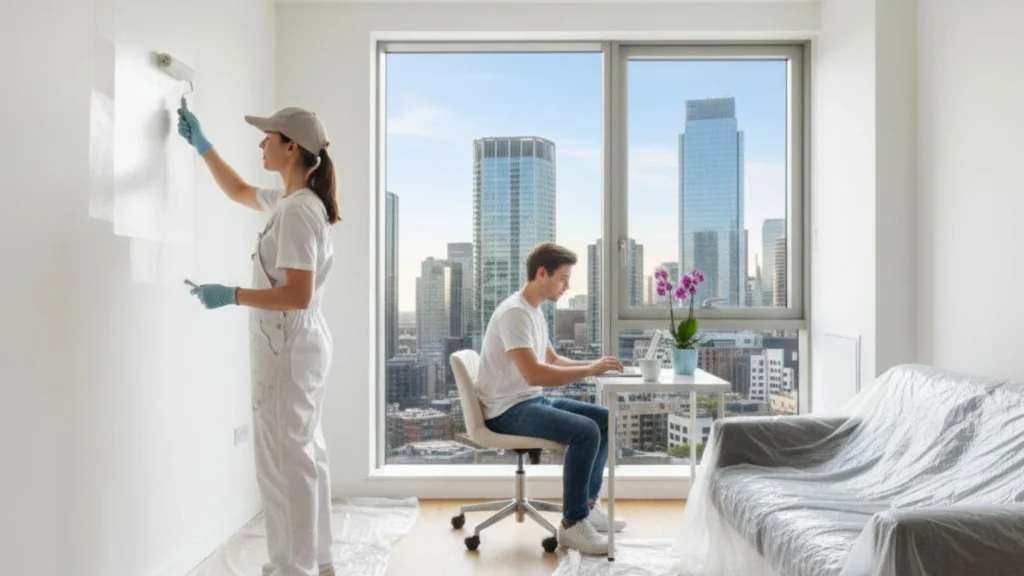
You’re having your Canary Wharf flat repainted. One bedroom. You work from home three days a week. The painter assured you the work wouldn’t be too disruptive. They’d paint the bedroom first while you worked in the living room. Then the living room while you worked in the bedroom. Simple room-by-room approach. You could stay in the flat throughout. No need to arrange alternative accommodation or take time off work.
Monday morning the painter arrives. Sets up in the bedroom. You settle at your desk in the living room with your laptop. First Teams call at 9am. By 9:30 you notice the smell. Paint fumes drifting through from the bedroom despite the door being closed. Subtle at first. By 10am it’s noticeable enough that you’re conscious of it during calls. By 11am you have a headache starting behind your eyes.
Lunchtime you open all the windows to ventilate. The smell reduces slightly. You close the windows because it’s freezing outside. The smell builds again immediately. Your headache intensifies. You take paracetamol. It doesn’t help much.
By 3pm you’ve abandoned work for the day. The paint fumes have given you a genuine headache, slight nausea, and difficulty concentrating on anything requiring focus. You can’t take client calls feeling like this. You can’t write reports with your head pounding. The painter finishes the bedroom. Beautiful work. Perfect coverage. The room looks stunning.
And you cannot physically be in your flat without feeling ill. You spend that night at a friend’s house because sleeping in paint fumes isn’t happening. Tuesday you try to work from the living room while the painter does the hallway. Same problem. Headache within two hours. Nausea by lunchtime. You abandon work again and leave the flat.
Welcome to the expensive reality of trying to occupy a flat during painting with standard high-VOC products that release concentrated chemical fumes in confined spaces. The painter’s room-by-room approach was sensible theoretically but completely impractical with products releasing fumes that pervade entire flats within hours and make occupancy genuinely unbearable for anyone with normal chemical sensitivity.
I’ve spent ten years painting occupied flats across Canary Wharf and Isle of Dogs. The number of residents who attempt to stay in their properties during standard painting and discover they physically cannot tolerate the fume levels is substantial because most painters never discuss VOC content or specify products appropriate for occupied painting unless explicitly required to.
Why Can’t You Stay In Your Flat During Standard Painting?
The impossibility of occupying flats during standard painting isn’t about being particularly sensitive or having low tolerance for disruption. It’s basic chemistry and confined space dynamics.
Standard emulsion releases volatile organic compounds continuously during application and drying. These VOCs evaporate from the wet paint, travel through the air, and pervade every space the air reaches. In a typical one or two bed Canary Wharf flat with perhaps fifty to seventy cubic metres of total air volume, painting one room releases enough VOCs to contaminate the entire flat’s air within two to three hours even with doors closed between rooms.
The health effects of VOC exposure in these concentrations include headaches, dizziness, nausea, eye and respiratory irritation, and difficulty concentrating. These aren’t severe toxicity symptoms. They’re nuisance level effects from moderate VOC exposure that make normal activities like working, sleeping, or cooking genuinely unpleasant or impossible depending on individual sensitivity.
The concentration doesn’t dissipate quickly even with windows open. VOCs continue releasing from wet and drying paint for hours after application. Opening windows reduces concentration temporarily but as soon as windows close the concentration builds again from ongoing off-gassing. Maintaining adequate ventilation to keep VOC levels below nuisance threshold requires windows open continuously for days, which is impractical during cold months and still doesn’t eliminate the problem completely.
The smell correlates with VOC concentration but doesn’t indicate safety. Some people can tolerate paint smell without experiencing health effects. Others develop headaches and nausea at smell levels barely noticeable to less sensitive individuals. Assuming paint smell is just an inconvenience rather than indicator of chemical exposure producing genuine health effects underestimates how unpleasant standard painting makes flats for occupants remaining during work.
What’s The Difference Between Low-VOC And Zero-VOC For Occupied Painting?
The terminology matters because the difference between low-VOC and zero-VOC determines whether occupied painting is uncomfortable or actually achievable.
Standard emulsion contains VOCs ranging from thirty to two hundred fifty grams per litre depending on formulation and colour. These products make occupied painting genuinely unbearable for anyone with normal chemical sensitivity. The fume levels in typical flats during standard painting exceed comfortable occupancy thresholds by substantial margins.
Low-VOC paint contains reduced volatile organic compounds, typically under fifty grams per litre and often under thirty grams per litre for premium formulations. This reduction substantially decreases fume intensity and makes occupied painting significantly more tolerable than standard products. Low-VOC painting in one room while occupying another room might be achievable for less sensitive individuals with good ventilation, though comfort depends heavily on individual tolerance and ventilation effectiveness.
Zero-VOC paint contains under five grams per litre of volatile organic compounds with many formulations containing genuinely zero measurable VOCs. These products produce minimal odour during application, negligible odour during drying, and essentially no ongoing off-gassing that affects occupancy comfort. Zero-VOC painting allows genuinely comfortable occupancy in other rooms during work and return to painted rooms within hours rather than days.
The practical difference is whether occupied painting means suffering through headaches and nausea hoping to tolerate it or actually comfortable occupancy while work progresses. Low-VOC products improve the situation substantially compared to standard formulations but zero-VOC products are what actually make occupied painting genuinely achievable without health effects for most people.
A Real Project: The South Quay Work From Home Disaster
One bed flat near South Quay. Owner worked from home full time. Needed the flat repainted throughout. Couldn’t afford to arrange alternative accommodation for the week painting would take because hotels or short-term rentals would cost more than the painting itself.
The owner discussed the situation with their painter. The painter confirmed they could work room by room so the owner could continue occupying the flat and working throughout. The owner assumed this meant the products being used were suitable for occupied painting. The painter assumed the owner could tolerate standard painting with windows open.
Day one was unbearable. Painter started the bedroom. Owner attempted to work from the living room. Within two hours the owner had developed a headache severe enough that concentrating on work was genuinely impossible. They abandoned work for the day. Spent the evening at a friend’s flat because sleeping in paint fumes wasn’t tolerable.
Day two repeated the pattern. Painter moved to the living room. Owner attempted to work from the bedroom. Same headache within two hours. Same inability to focus. Same abandonment of work and evacuation for the evening. The owner was losing income from work they couldn’t complete while paying for accommodation elsewhere because their own flat was uninhabitable.
By day three the owner contacted us. Could the flat be repainted with products that actually allowed occupancy during work? They couldn’t afford another week of lost work and accommodation costs. They needed painting that genuinely meant they could stay in the flat and work normally while it happened.
We repainted using certified zero-VOC products throughout. Same scope. Same colour. Same coverage standards. Completely different product formulation producing essentially zero odour during application and drying.
The owner worked normally throughout the repainting. No headaches. No nausea. No evacuation necessary. They could be in the same room while we painted other walls without discomfort. They slept in the flat every night during the work. The difference between standard products requiring evacuation and zero-VOC products allowing comfortable occupancy was dramatic proof that product selection determines whether occupied painting is theoretical or actually achievable.
What Does Genuine Odour-Free Painting Actually Require?
Professional low-odour painting for occupied flats requires specific products and working methods beyond simply opening windows and hoping for the best.
Zero-VOC paint specification throughout the property. Not low-VOC marketed as suitable for occupied painting. Genuinely zero or near-zero VOC formulations certified for minimal off-gassing. The specification matters because low-VOC products, while better than standard, still produce fume levels that make occupancy uncomfortable for many people particularly in small flats with limited air volume.
Application scheduling that maximises occupant comfort. Painting rooms in sequence that allows occupants to use other areas comfortably. Starting furthest from living areas and progressing toward them so completed areas are available for occupancy while work continues elsewhere. Scheduling work during hours when occupants might naturally be elsewhere if possible.
Ventilation planning that accounts for product used. Zero-VOC products need minimal ventilation and allow comfortable occupancy with standard air circulation. Low-VOC products need active ventilation during application and for several hours afterward. Understanding which ventilation approach suits the products specified prevents uncomfortable surprises during work.
Communication about realistic comfort expectations. Zero-VOC products allow genuinely comfortable occupancy during work. Low-VOC products allow tolerable occupancy with good ventilation for less sensitive individuals. Standard products make comfortable occupancy essentially impossible regardless of ventilation. Being explicit about what occupants should expect prevents assumptions creating disappointment.
What Should E14 Residents Demand From Occupied Painting Specialists?
Zero-VOC product specification confirmed explicitly for occupied painting. Not low-VOC described as suitable. Genuinely zero-VOC throughout all areas. If they’re proposing low-VOC products for occupied painting, comfort during work depends on individual tolerance rather than being reliably achievable.
VOC content documentation provided for proposed products. Zero-VOC claims should be verified through product specifications showing actual measured VOC levels. If they can’t provide VOC documentation, the low-odour claim might be marketing rather than measurable reality.
Occupancy comfort discussion before work begins. Can you actually work, sleep, and live normally in the flat during painting? With zero-VOC products, yes. With low-VOC products, maybe depending on sensitivity. With standard products, no. If they’re not being explicit about realistic expectations, assumptions will create problems.
Room sequencing plan confirmed. Which rooms get painted in which order to maximise your ability to use other spaces comfortably? If they haven’t considered scheduling relative to your occupancy needs, the work might be inconvenient even with appropriate products.
Get Your Flat Painted While Actually Living In It
Occupied painting requires understanding that standard products make comfortable occupancy impossible regardless of ventilation and that genuinely odour-free painting demands zero-VOC products specified explicitly for that purpose. Low-VOC marketing suggesting occupied painting is achievable often means tolerable rather than comfortable and depends heavily on individual chemical sensitivity.
We specialise in occupied flat painting across Canary Wharf and Isle of Dogs. We specify certified zero-VOC products throughout. We schedule work to maximise occupant comfort. We communicate realistic expectations. And we produce results allowing genuinely comfortable occupancy during painting rather than theoretical occupancy requiring tolerance for headaches and nausea.
Call for quote now: 07507 226422 Email: hello@havenedge.co.uk Website: www.havenedge.co.uk
CSCS certified, fully insured, experienced with odour-free painting across E14. Your flat deserves zero-VOC products allowing genuine comfortable occupancy rather than standard products requiring evacuation and accommodation costs.