
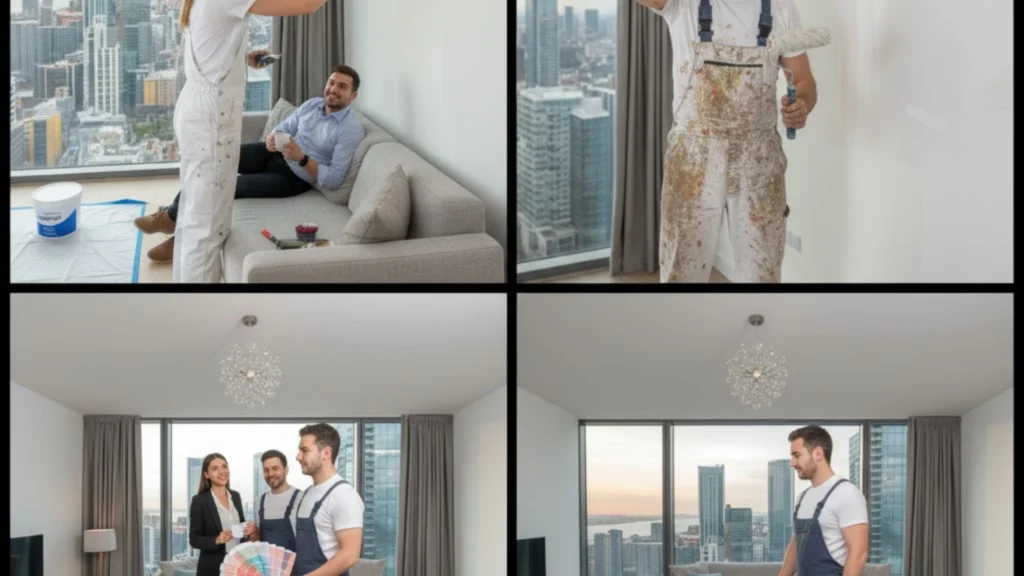
E14 painters vs DIY painting seems like an obvious choice when you’re looking at your Canary Wharf flat thinking how hard can painting really be? You watched a YouTube tutorial. Looks straightforward. Roller on the walls, brush around the edges, two coats, job done. You’ll save hundreds by doing it yourself over a weekend. Maybe a long weekend if it takes slightly longer than expected.
You buy paint from B&Q. Good quality stuff, not the cheapest. Rollers, brushes, masking tape, dust sheets. The equipment costs more than you anticipated but it’s still cheaper than hiring someone. Friday evening you move furniture into the middle of the room, tape around the edges, lay dust sheets, and feel genuinely accomplished before you’ve even started painting.
Saturday morning you pour paint into the tray and start rolling the first wall. The coverage is patchy. The tutorial made it look smooth and even. Yours has visible roller marks and thin sections where the base colour shows through. You apply more pressure. The roller skids across the wall leaving thick ridges. You apply less pressure. The coverage gets worse.
By lunchtime you’ve completed one wall. It looks amateur. Uneven coverage throughout. Thick paint along one edge where you went over the same section repeatedly. The masking tape has somehow let paint bleed underneath, creating a wavy line where wall meets ceiling that should be straight. You’ve got paint on the carpet despite the dust sheets because you stepped off them while concentrating on cutting in around the window.
Sunday evening you’ve finished two coats on all walls. You’re exhausted. Your back aches from the unfamiliar postures required for cutting in along ceilings. Your arms hurt from holding the roller at awkward angles for extended periods. The room looks painted but not professionally painted. Visible roller marks throughout. Uneven coverage in patches. Ceiling lines that aren’t straight. Paint on the carpet that won’t come out.
Monday you Google painters to fix what you’ve created. You discover professional remediation costs more than professional painting would have cost initially because correcting DIY work requires stripping back to base condition before starting properly.
Welcome to the expensive reality that DIY painting saves money only if you can actually achieve acceptable results. Most Canary Wharf residents attempting DIY discover that the skill gap between watching tutorials and executing professional finish is substantially wider than YouTube suggests.
I’ve spent ten years painting professionally across Canary Wharf and Isle of Dogs. The number of flats where I’m called to remediate DIY attempts that went wrong is genuinely substantial because the confidence boost from watching tutorials doesn’t translate into the skill required for professional execution.
Why Is DIY Painting Harder Than YouTube Tutorials Suggest?
The gap between watching someone paint and actually painting yourself is considerably wider than most people anticipate.
Professional cutting in requires steady hands, correct brush technique, and experience maintaining consistent pressure and angle throughout long straight lines. Tutorials show the end result but don’t convey how difficult maintaining that consistency is throughout an entire room when your arms are tired and your concentration is fading. The wavy ceiling lines DIY attempts produce aren’t from lack of effort. They’re from lack of muscle memory that professional painters develop over thousands of hours.
Even roller coverage requires technique most people don’t realise exists. The pressure varies throughout the stroke. The angle changes based on wall section. The overlap between passes follows specific patterns. Professional painters execute this technique automatically. DIY painters discover halfway through that they’ve created visible texture variations because their technique isn’t consistent.
Surface preparation determines finish quality more than application skill. Professionals spend substantial time preparing surfaces before paint touches walls. Washing to remove contamination. Filling every crack and hole. Sanding repairs absolutely flush. Priming appropriately. DIY painters typically skip preparation steps they didn’t realise existed or consider them optional extras rather than fundamental requirements for acceptable results.
Product selection affects results substantially. Professionals specify products based on substrate, existing condition, desired finish, and application method. DIY painters buy whatever B&Q recommends without understanding that product selection determines whether two coats produce professional coverage or questionable results requiring additional coats.
The physical stamina required for painting entire flats surprises most DIY attempts. Cutting in along ceilings requires sustained uncomfortable postures. Rolling entire walls requires repetitive arm movements for hours. The back and shoulder fatigue builds throughout the day. Professional painters have physical conditioning for sustained work. DIY painters discover muscles they didn’t know existed by Sunday evening.
What’s The Actual Time Cost Of DIY Versus Hiring Professionals?
The time comparison between DIY and professional painting reveals why weekend projects extend into week-long ordeals.
Professional painters estimate labour time based on experience with hundreds of similar properties. A two bedroom Canary Wharf flat requires perhaps three to four days of professional work depending on existing condition and scope. That’s based on eight hour working days, correct equipment, professional technique, and no learning curve.
DIY painters typically estimate time based on active painting hours without accounting for preparation, cleanup, equipment acquisition, learning curve, and mistakes requiring correction. The mental estimate of a weekend project assumes everything proceeds smoothly, no errors occur, and application happens at professional speed despite zero experience.
The reality multiplies estimated time substantially. Equipment acquisition takes half a day if you don’t already own everything needed. Surface preparation takes longer than anticipated because you’re learning what adequate preparation actually requires. Application takes three to four times longer than professional speed because technique is unpractised. Mistakes require correction time. Cleanup after each session takes longer than expected.
The two bedroom flat that professionals complete in four working days becomes ten to fifteen days of DIY work spread across three weekends and multiple evenings. The time cost isn’t just the hours spent painting. It’s the weeks your flat is disrupted, furniture is piled in room centres, and living conditions are chaotic.
Opportunity cost amplifies time expenditure. Those three weekends could have been spent doing things you actually enjoy or earning income through your actual profession. Trading fifteen days of your time to avoid four days of professional labour only makes economic sense if your free time has zero value.
A Real Project: The South Quay DIY Disaster Recovery
Studio flat near South Quay. Owner decided to repaint the entire space themselves to save money. Confident they could achieve acceptable results after watching several YouTube tutorials and reading DIY decorating guides.
Week one the owner completed the main living area. The walls were painted but the finish quality was noticeably amateur. Roller marks visible throughout. Uneven coverage in patches where paint had been applied too thin. Ceiling lines that wavered rather than running straight. The owner was disappointed but convinced the bedroom would go better now they’d learned from living room mistakes.
Week two the bedroom received the same treatment. Slightly better technique from practice but still visibly amateur results. More roller marks. More uneven coverage. The improvement from living room to bedroom was marginal because fundamental technique gaps don’t resolve through limited practice.
Week three the owner stood back and assessed the complete result. The flat was painted throughout. But it looked like someone had painted it themselves rather than professionally finished. The owner had invested three weekends plus multiple evenings totalling roughly forty hours of work. The result was acceptable for rental property standards but disappointing for their own home where they’d wanted professional finish.
They contacted us asking whether the DIY work could be improved to professional standard. Could we correct the roller marks, fix the uneven coverage, straighten the ceiling lines, and produce the finish they’d actually wanted when they started this project?
We explained that remediation would cost more than professional painting would have cost initially. The DIY paint needed sanding down in sections to remove texture variations. The ceiling lines needed cutting in properly using professional technique. The uneven coverage needed additional coats to achieve consistency. The total remediation work exceeded starting from bare walls because correcting existing work is harder than executing correctly first time.
The owner chose full remediation. The total cost between their DIY attempt including materials and equipment and our professional remediation exceeded what professional painting throughout would have cost by roughly thirty percent. They’d spent forty hours of personal time, several hundred pounds on materials and equipment, and then paid more for professional remediation than original professional painting would have cost.
The expensive lesson was that DIY saves money only if the result is actually acceptable. Unacceptable DIY results require professional correction costing more than professional execution would have cost initially.
What Do Professional Painters Actually Provide Beyond Just Applying Paint?
Professional painting delivers substantially more value than simply getting paint onto walls.
Expertise in surface assessment and preparation prevents problems before they occur. Professionals identify issues like loose plaster, contamination requiring specialist cleaning, or substrate damage requiring repair before any painting begins. DIY painters discover these problems partway through when paint doesn’t adhere properly or contamination bleeds through topcoat.
Professional finish quality through correct technique executed consistently. Even coverage throughout. Straight cutting in along all edges. Invisible repairs beneath fresh paint. The finish difference between professional work and DIY attempts is immediately obvious to anyone looking at completed results.
Appropriate product specification for the specific situation. Professionals select primers, undercoats, and topcoats based on what the substrate and existing condition actually require. DIY painters use generic products without understanding that specification determines whether results meet expectations.
Efficiency from experience and correct equipment. Professional painters complete work in a fraction of the time DIY attempts require because technique, equipment, and process are optimised through years of experience. The time saving alone often justifies professional costs for residents whose free time has value.
Warranty and accountability for results. Professional painters provide written warranties and stand behind their work. If problems appear after completion, professional painters correct them. DIY painters have nobody to call when results disappoint except professional painters to fix what they’ve created.
When Does DIY Make Sense Versus When Should You Hire Professionals?
The decision between DIY and professional painting depends on specific circumstances rather than universal rules.
DIY makes sense for small contained projects where results matter less than cost. Painting inside a storage cupboard. Refreshing a small utility room. Touch-ups to existing paintwork in non-visible areas. These situations allow practising technique on low-stakes surfaces where amateur results don’t matter.
Professional painting makes sense for visible living spaces where finish quality affects daily satisfaction. Living rooms, bedrooms, kitchens, anywhere you see constantly deserves professional finish. The quality difference is visible every time you’re in the space.
DIY makes sense if you genuinely enjoy painting as an activity. Some people find painting meditative and satisfying. If you derive genuine enjoyment from the process, time spent painting isn’t opportunity cost. It’s recreation that happens to improve your property.
Professional painting makes sense if you dislike painting or value your free time highly. Trading weekends and evenings to save money only makes sense if your free time has minimal value. Most Canary Wharf residents earn enough that their hourly rate makes DIY painting economically questionable even before considering result quality.
DIY makes sense if you have realistic expectations about achievable results. If you accept that DIY finish will look amateur and you’re comfortable with that, DIY might be appropriate. If you expect professional results from unpractised technique, disappointment is guaranteed.
Professional painting makes sense when selling or letting property. Amateur finish reduces perceived value and potentially affects sale or rental prices. Professional finish is investment in property value rather than pure expense.
Get Results That Actually Justify The Disruption
DIY painting trades your time, effort, and tolerance for amateur results against the cost of professional work. For some situations that trade makes sense. For most Canary Wharf flats where residents value their time and want professional finish in their living spaces, professional painting delivers substantially better value than DIY attempts.
Understanding what professional painters actually provide beyond labour clarifies why professional costs reflect genuine value. Expertise, efficiency, appropriate products, professional finish, and warranty backing justify costs that seem high until compared against DIY time investment and result disappointment.
We provide professional painting across Canary Wharf and Isle of Dogs. We assess surfaces properly. We prepare thoroughly. We specify products appropriately. We execute with professional technique. We complete efficiently. And we provide written warranties backing our workmanship.
Call for quote now: 07507 226422 Email: hello@havenedge.co.uk Website: www.havenedge.co.uk
CSCS certified, fully insured, experienced across E14. Your flat deserves professional finish rather than DIY attempts requiring expensive remediation.