
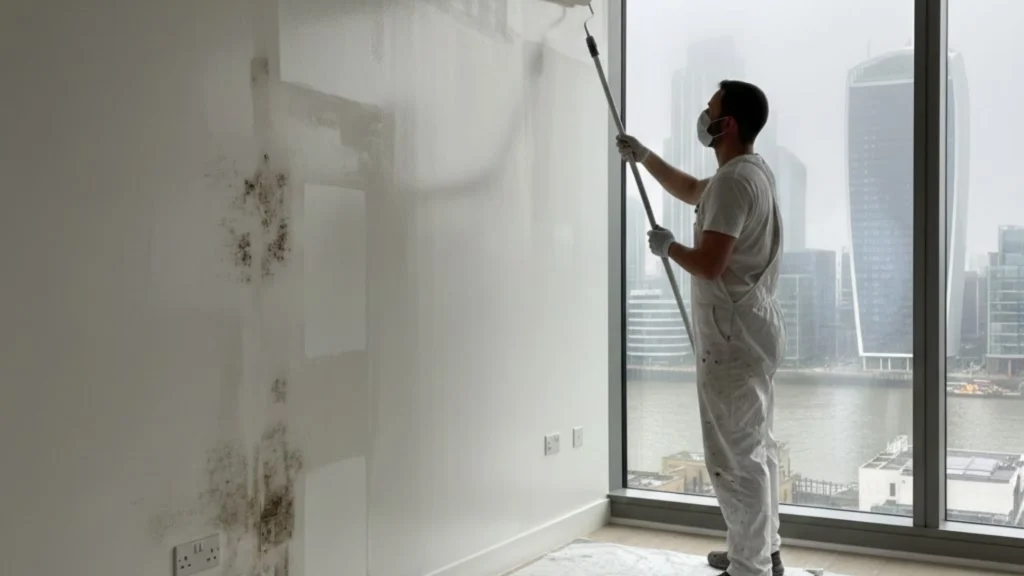
You moved into your Canary Wharf flat six months ago. Beautiful property. Everything you wanted except one small issue the estate agent mentioned almost in passing during the viewing.
“Tiny bit of mould in the bedroom corner. Previous tenant wasn’t great at ventilating. Just needs anti-mould paint and it’ll be sorted.”
Fine. You bought the flat. Painted the bedroom corner with anti-mould emulsion from B&Q. Two coats. The black spots disappeared underneath fresh white paint. Problem sorted. You’re pleased with yourself for handling it efficiently.
Eight weeks later you notice a dark patch in exactly the same corner. Small at first. By week twelve it’s visible from across the room. Black spots spreading outward from precisely where the original mould was, growing steadily despite the anti-mould paint supposedly preventing exactly this.
You paint over it again. Fresh coat of the same anti-mould emulsion. Mould disappears again. Six weeks later it’s back. Slightly larger this time. You paint over it a third time. It comes back a third time. Slightly faster now.
Six months after moving in you’ve painted that corner three times. Each coat covers the mould temporarily. Each coat fails to stop it returning because the mould isn’t a painting problem. It’s a damp problem that painting alone cannot solve and no amount of anti-mould emulsion will ever permanently resolve.
Welcome to the expensive cycle of painting over mould repeatedly without addressing what’s actually causing it. Mould grows because moisture exists in your walls. Anti-mould paint covers the visible mould but doesn’t remove the moisture feeding it. The cycle repeats indefinitely until someone treats the underlying damp condition rather than simply covering the symptom.
I’ve spent ten years dealing with mould across Canary Wharf and Isle of Dogs. The painting-over-mould cycle is one of the most common and expensive mistakes residents make because everyone assumes mould is a painting problem when it’s actually a moisture problem that painting can only address once the source has been properly identified and treated.
Why Does Mould Keep Coming Back No Matter How Many Times You Paint Over It?
Mould is a living organism that feeds on moisture and organic matter present in building materials. When moisture exists inside your walls, mould has everything it needs to grow, spread, and reproduce continuously regardless of what you paint over it.
Anti-mould paint contains biocide compounds that kill mould on contact. When you paint over active mould, the biocide kills the visible growth on the surface. The paint looks clean and fresh. Problem appears solved. But the moisture inside the wall hasn’t changed. The conditions that produced mould in the first place still exist exactly as they did before you painted over it.
Within weeks the moisture feeds new mould growth from spores already present deep in the wall substrate. The new growth pushes through the paint layer from underneath, reappearing in exactly the location where moisture concentration is highest. The cycle repeats because you’re treating the symptom without treating the cause.
Genuinely stopping mould requires identifying why moisture is present, treating that source appropriately, allowing affected areas to dry completely, killing existing mould contamination within the substrate, and only then applying anti-mould coating as a preventative measure rather than a cure for active growth. Skipping straight to painting guarantees the repeating cycle described above.
What’s The Difference Between Condensation Mould And Penetrating Damp In E14 Flats?
This distinction determines everything about whether painting solutions can genuinely help or whether painting is completely irrelevant to your problem.
Condensation mould develops when moisture generated inside your flat meets cold wall surfaces and condenses into liquid water. Cooking, showering, breathing, drying clothes, all produce moisture that settles on the coldest surfaces available. Condensation mould typically appears in corners where walls meet ceilings, around window frames, behind furniture against external walls, and anywhere cold bridging creates particularly cold surface temperatures.
Condensation mould is genuinely addressable through improved ventilation, treating cold bridging where possible, and appropriate anti-mould coating once condensation has been managed. Painting solutions form part of the treatment because the underlying cause can be reduced and surfaces protected with appropriate coatings.
Penetrating damp means moisture entering your flat from outside. Through cracks in external walls, failed pointing, damaged roof elements, or water finding its way through the building envelope from an external source. This moisture travels through wall structure and appears internally as dampness, discolouration, and eventually mould growth where it emerges.
Penetrating damp cannot be solved by painting. No amount of anti-mould paint stops moisture travelling through concrete or brick from an external source. The entry point must be identified and repaired externally before internal painting becomes remotely relevant to your problem.
Rising damp affects ground floor and basement flats where moisture travels upward through foundations from the ground below. Rising damp produces distinctive patterns, typically appearing from the bottom of walls upward with tide marks showing the highest moisture level reached. Rising damp requires damp proof course treatment or specialist barrier installation. Painting solutions are completely irrelevant until rising damp has been professionally treated.
Canary Wharf and Isle of Dogs flats experience all three types depending on the development, the flat’s position within the building, and the property’s construction history. Identifying which type you’re dealing with determines whether painting is part of the solution or completely beside the point.
A Real Project: The South Quay Mould Cycle
Two bed flat on South Quay Plaza. The owner had been battling mould in the living room corner for the better part of eighteen months before contacting us. Not a bathroom. Not a kitchen. The living room, where condensation mould had no obvious reason to establish itself according to the owner’s understanding.
They had painted over the mould three times previously with anti-mould emulsion purchased from the hardware shop. Each time the mould disappeared for a few weeks and returned slightly more aggressively than before. By the time they called us the mould had spread from a single corner patch to a continuous dark band running along the junction where two walls met the ceiling.
The moisture source wasn’t condensation from lifestyle activities. The flat was well ventilated. The owner cooked with windows open, showered with the extractor running, and didn’t dry clothes indoors. Under normal circumstances this flat should not have produced condensation mould in the living room.
The moisture was penetrating from outside. The development had a communal roof terrace two floors above. A waterproofing failure on that terrace had allowed water to travel through the building structure downward over several years. The moisture wasn’t visible as obvious water ingress on any surface. It was travelling through concrete and insulation layers, emerging as dampness within the wall structure at exactly the living room ceiling level where the mould had established itself.
This is precisely the scenario where painting produces the repeating cycle. The moisture source was external and structural. No amount of anti-mould paint on the internal surface could stop water travelling through concrete from a failed waterproofing system two floors above.
Building management arranged repair of the external waterproofing once the source was identified. Once repaired, the affected wall areas needed time to dry out completely before any treatment could begin. Moisture meters confirmed the walls had reached acceptable dryness levels before we touched anything.
We treated and painted properly after the moisture source was resolved. Specialist mould killer applied throughout the affected area with adequate dwell time to kill active mould and begin neutralising spores within the plaster surface. Sections of plaster that had become unstable from prolonged moisture exposure were removed and replastered before any coating work proceeded.
Anti-mould primer applied over the treated and prepared surfaces. Specialist anti-mould emulsion in two full coats over the primer. The mould hasn’t returned in the fourteen months since completion because the moisture feeding it no longer exists.
What Does Proper Mould Treatment And Painting Actually Involve?
The sequence matters enormously. Skipping stages produces exactly the repeating cycle described at the start of this post.
Moisture source identification comes first. Before any painting or treatment begins, understanding why moisture is present where it is. Is this condensation from lifestyle activities? Moisture entering from outside through a structural fault? Moisture rising from below? Each source requires completely different treatment before painting becomes relevant.
Damp specialist assessment is necessary where penetrating or rising damp is suspected. Painters treat surfaces. Damp specialists diagnose moisture sources and treat the underlying cause. If your mould is caused by moisture entering from outside or rising from below, a damp specialist needs to identify and treat that source before any painting work begins.
Mould killer treatment on all affected surfaces before any painting. Specialist mould killer solution applied with adequate dwell time for the treatment to work. Not anti-mould paint applied directly over visible mould. The mould killer stage kills active growth and begins neutralising spores within the surface layer. This cannot be skipped.
Complete surface preparation after mould killer treatment. Loose mould, contaminated paint, and unstable plaster removed thoroughly. Surfaces brought to genuinely clean, stable condition before any new coating goes on.
Anti-mould primer followed by specialist anti-mould emulsion topcoat. Not standard emulsion with biocide added at the paint counter. Genuine specialist anti-mould formulations throughout the coating system provide significantly better long-term protection than standard products with added biocide.
What Should E14 Residents Demand From Damp And Mould Specialists?
Moisture source identification confirmed before any treatment begins. They should explain what’s causing the moisture before proposing any treatment. If they’re suggesting anti-mould paint without first identifying the moisture source, they’re proposing to cover the symptom rather than treat the cause.
Moisture content testing on affected walls before painting. Walls must test as genuinely dry before painting solutions can work. If they’re proposing to paint without testing moisture content first, they might be painting walls that are still actively damp, which guarantees mould regrowth regardless of coating applied.
Mould killer treatment confirmed as a separate stage before painting. Anti-mould paint applied over active mould without specialist mould killer treatment first produces temporary coverage followed by rapid regrowth.
Genuine specialist anti-mould products specified throughout. Not standard emulsion with biocide mixed in at the counter. Specialist anti-mould primer and specialist anti-mould emulsion formulated specifically for mould-affected environments provide protection that standard products cannot match.
Get Your Mould Problem Actually Solved
Mould in your Canary Wharf flat isn’t a painting problem. It’s a moisture problem that painting solutions can address only once the moisture source has been identified and treated appropriately. Painting over active mould repeatedly without addressing what feeds it produces an expensive cycle that continues indefinitely until the underlying cause is resolved.
We work alongside damp specialists across Canary Wharf and Isle of Dogs to deliver genuine mould treatment from source identification through to specialist anti-mould coating. We don’t paint over mould and call it sorted. We treat surfaces properly, specify genuine specialist products, and produce results that actually last because the underlying cause has been addressed rather than simply covered.
Call for quote now: 07507 226422 Email: hello@havenedge.co.uk Website: www.havenedge.co.uk
CSCS certified, fully insured, experienced with mould treatment and anti-mould coating across E14 including condensation mould, post-damp remediation painting, and specialist surface treatment for persistent mould problems. Your walls deserve treatment that actually stops the mould rather than simply hiding it until it comes back again.
Whether first time mould treatment, breaking the painting-over-mould cycle that’s been repeating for months, or specialist anti-mould coating following professional damp remediation, genuine mould solutions require understanding moisture first and painting second.