
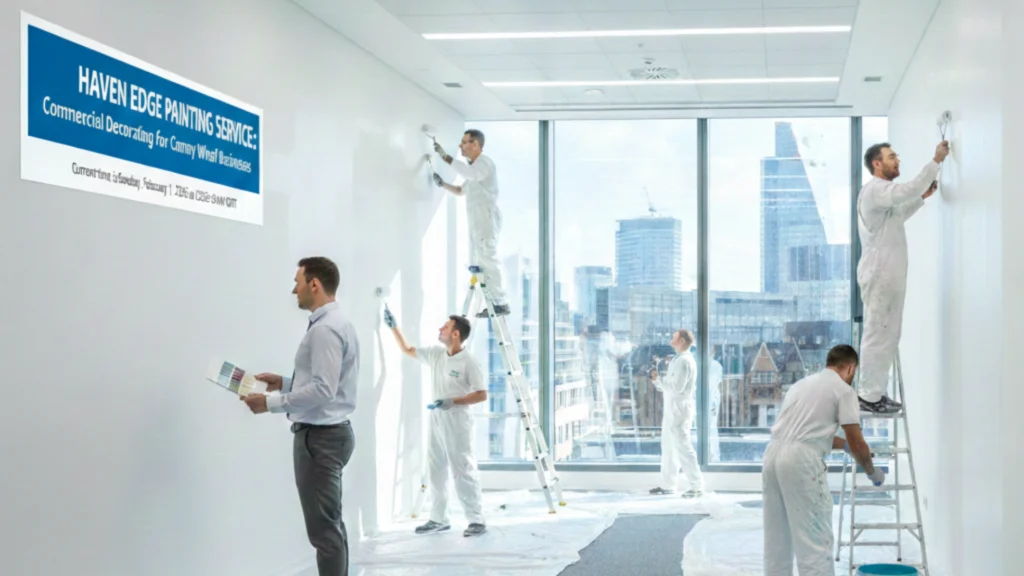
Monday morning. 8:15am. Your first employee walks through the office door, takes one look at the walls, and stops dead. Not because they look stunning. Because the paint is still wet. Literally wet. The roller marks are visible. There’s a strip along the skirting board where someone clearly ran out of patience with the masking tape and just painted freehand. And the ceiling, which was supposed to get two coats, has one coat that’s visibly uneven with the old water stain showing through like a ghost.
The painters were supposed to finish Sunday evening. They left at 3pm Sunday afternoon because one of them had somewhere to be. The job manager didn’t check before handing you the keys back. Nobody bothered to verify the work was actually finished before telling you it was done.
Now you’ve got thirty employees arriving in forty five minutes to a half finished, paint-smelling office that looks worse than it did before anyone touched it. Your meeting room has chairs pushed against one wall where painters left them after moving furniture to access the walls. Two chairs are missing entirely. Nobody knows where they went.
Your Monday morning team meeting happens in an office that smells of fresh paint, looks amateur, and makes your entire business look unprofessional to the three prospective clients visiting this week for presentations.
Welcome to the catastrophic reality of hiring residential painters for commercial work. Office painting in Canary Wharf isn’t about slapping colour on walls during business hours and hoping nobody notices. It’s a completely different discipline requiring specialist understanding of commercial environments, business operations, and the unique pressures offices face.
I’ve spent ten years painting offices across Canary Wharf and the wider E14 area. The number of businesses I’ve seen damage their own professional reputation by hiring painters who didn’t understand commercial environments is genuinely staggering.
Why Office Painting Is Completely Different
Painting someone’s living room and painting someone’s office are fundamentally different jobs despite involving the exact same materials and techniques. The environment, the constraints, the consequences of failure, and the entire working methodology are different.
Time is measured in business impact, not convenience. Your home can be painted while you’re at work. Your office can’t be painted while you’re at work because you’re at work in it. This means office painting happens outside business hours, weekends, bank holidays, or during very specific windows when sections of the office can be isolated without disrupting operations.
Residential painters think about time in terms of how long the job takes. Commercial painters think about time in terms of when the business can actually tolerate the work happening. These are completely different calculations.
The finish needs to withstand commercial punishment. Office walls get touched constantly. Chairs pushed against them. Things leaned against them. Bags dropped against them. Fingers touching them when people lean or gesture during conversations. Commercial environments are physically harder on painted surfaces than domestic ones by a significant margin.
Residential paint and residential preparation produce beautiful finishes that show damage within weeks in an office environment. Commercial specification paint and proper commercial preparation produce finishes that withstand daily office punishment for years.
Brand identity sometimes dictates the colours. Some Canary Wharf businesses have specific brand colours that need matching precisely. A financial services firm might need their reception painted in their exact corporate navy. A tech startup might need their meeting rooms in specific brand colours that clients associate with their identity.
Colour matching to brand specifications requires precision that generic residential painters simply haven’t encountered. Getting it wrong doesn’t just look bad. It potentially conflicts with brand guidelines that marketing departments spend serious money establishing.
The professional impression matters enormously. Clients visit offices. Prospective employees interview in offices. Partners and investors tour offices. Every single one of them forms an impression within seconds based partly on how the space looks and feels.
A badly painted office communicates carelessness, unprofessionalism, and lack of attention to detail. These are exactly the qualities no business wants associated with their brand, regardless of their actual service quality.
The Canary Wharf Office Challenge
E14 offices present specific complications that intensify every aspect of commercial painting.
The after-hours access situation is genuinely complicated. Canary Wharf buildings have strict security protocols for after-hours contractor access. Weekend work requires advance authorisation. Overnight work requires specific documentation. Some buildings restrict when contractors can use service lifts, when they can make noise, and what areas they can access outside business hours.
Painters who don’t understand these protocols waste days sorting access that experienced commercial painters have already arranged. Every day lost to access problems is a day the business can’t use its office properly.
The building management expectations are higher. Commercial tenants in Canary Wharf pay significant service charges. Building management companies expect contractors working in commercial spaces to meet higher standards of professionalism, compliance, and care than residential contractors face. Insurance requirements are more stringent. Documentation expectations are more detailed.
Residential painters encounter building management occasionally. Commercial painters in Canary Wharf deal with building management constantly and understand exactly what’s required.
The noise sensitivity is extreme. Offices in shared buildings have neighbours. Other businesses on the same floor, above, below. Sanding, drilling, moving furniture, all create noise and vibration that affects neighbouring tenants. Building management receives complaints instantly when commercial contractors make excessive noise.
Commercial painters understand noise management in shared office buildings. Residential painters who’ve only worked in residential buildings haven’t encountered this level of sensitivity.
The speed requirement is absolute. A Canary Wharf business paying significant rent for office space cannot have that space sitting unusable for extended periods while painting drags on. The work needs to happen fast enough that business disruption is genuinely minimal.
Painters who underestimate the speed requirement create situations where businesses are paying rent on space they can’t actually use, which is extraordinarily expensive.
A Real Project: The Montgomery Square Office
Here’s a situation that demonstrates exactly why commercial painting needs genuine specialist understanding.
Tech company occupying a medium sized office in Montgomery Square. Growing fast, needed the space refreshed to reflect their current brand identity rather than the generic white box they’d inherited from the previous tenant. Reception needed their brand colour. Meeting rooms needed specific colours from their brand guidelines. Open plan area needed something that felt energetic and modern without being distracting.
They hired a painter who did excellent residential work across Canary Wharf. Beautiful results in flats and houses. Genuinely talented painter with impressive portfolio. But had never painted a commercial space before.
The planning went wrong from the start. The painter suggested doing the work over one weekend, starting Saturday morning and finishing Sunday evening. Sounded reasonable on paper. Didn’t account for the building’s Saturday access restrictions, which required advance authorisation that nobody had arranged.
Saturday morning the painter turned up at 7am. Building security wouldn’t let them in without prior authorisation. The entire Saturday was lost sorting the access situation. Now the entire job needed completing in one day, Sunday, which was never realistic for the scope of work involved.
The brand colour matching was disastrous. The company provided their brand colour specifications. Hex codes, Pantone references, the exact colours their marketing team had established as non-negotiable brand elements.
The painter mixed colours by eye based on the hex codes, assuming close enough would be fine. The reception wall ended up a visibly different shade to the brand specification. Not dramatically wrong. Just subtly off in a way that anyone who’d seen their brand guidelines would notice immediately.
The company’s marketing director walked in Monday morning, looked at the reception wall, and immediately flagged that the colour was wrong. Fixing it meant repainting the entire reception wall, which meant another weekend of disruption, another access coordination exercise, and another Monday morning where the office looked unfinished.
The open plan area created problems nobody anticipated. The painter used standard interior emulsion for the open plan walls. Beautiful colour, lovely finish, completely inappropriate for a space where chairs get pushed against walls thirty times a day by thirty different people.
Within three weeks, the paint was showing scuffs and marks everywhere. The office looked shabby almost immediately because residential grade paint simply cannot withstand commercial traffic levels.
We were brought in to fix everything. Properly coordinated building access for the remediation work, scheduling around the company’s client meetings and team events. Colour matched the brand specifications precisely using professional colour matching rather than eyeballing hex codes. Repainted all surfaces with commercially appropriate products specified for high traffic environments.
The result looked genuinely professional and lasted. The previous painter’s work had cost the company time, credibility with their marketing team, and the expense of having everything redone properly.
What Commercial Office Painting Actually Requires
Let me be specific about what understanding commercial environments actually means for painters.
After-hours workflow planning. Commercial painting almost always happens outside business hours. This means planning an entire job around evening and weekend windows, understanding how long each element actually takes under time pressure, and delivering genuinely finished results within those windows.
Residential painters plan around their own schedule. Commercial painters plan around the business’s operational requirements. Completely different mindset.
Commercial grade specification. Walls in offices need commercial grade paint designed to withstand daily physical contact from multiple people. Reception areas need particularly durable finishes because they’re the first thing clients see and the area that gets most foot traffic. Meeting rooms need washable finishes because spills and marks happen constantly.
Using residential specification in commercial spaces produces results that deteriorate visibly within weeks. Commercial specification products cost slightly more but last dramatically longer in office environments.
Precise colour matching capability. Brand colours need matching exactly, not approximately. This requires professional colour matching using proper spectrophotometric equipment or working directly with paint manufacturers who can produce bespoke mixes from brand specifications.
Painters who mix colours by eye from hex codes produce results that look wrong to anyone familiar with the brand. This isn’t about being fussy. It’s about brand consistency that businesses spend serious money maintaining.
Furniture and equipment handling. Offices contain expensive furniture, computer equipment, monitors, servers, sensitive documents. All of this needs protecting during painting work. Commercial painters understand how to work around office equipment efficiently, protecting everything properly without creating chaos that takes hours to sort afterwards.
Residential painters protect furniture with dust sheets. Commercial painters protect furniture, equipment, cables, monitors, keyboards, and everything else that exists in an office environment.
Noise and disruption management. Commercial spaces in shared buildings require awareness of neighbouring tenants. Noise management during preparation work, dust control, and general professional behaviour around a shared commercial environment all matter enormously.
Painters who treat commercial spaces like residential ones create neighbour complaints that reflect on your business and potentially on your tenancy within the building.
The Reception Area Specifically
Reception areas deserve special attention because they’re the single most important painted surface in any office.
First impressions happen in three seconds. A client walking into your reception forms an opinion about your business before they’ve even spoken to anyone. The walls, the ceiling, the finish quality, all contribute to that instant impression.
A reception that looks professionally painted communicates competence and care. A reception that looks rushed or shabby communicates the opposite, regardless of how brilliant your actual service is.
The traffic level is highest here. Everyone enters and exits through reception. Client meetings start and end there. Deliveries arrive there. The walls in reception get more physical contact than any other surface in the office.
This means reception walls specifically need the most durable commercial finish available. Cutting corners on reception paint specification is cutting corners on your business’s first impression.
The brand colour impact is maximum here. If your brand colour appears anywhere in your office, it’s usually reception. Getting this colour wrong is maximally visible because it’s the first thing every visitor sees.
Precise colour matching in reception isn’t optional. It’s the single most visible brand expression in your physical space.
The Weekend Work Reality
Office painting almost always happens on weekends, and this creates specific challenges worth understanding.
Saturday and Sunday are not equivalent. Some Canary Wharf buildings have different access protocols for Saturday versus Sunday. Some have reduced security on one day versus the other. Some have building maintenance scheduled on specific days that conflicts with contractor access.
Commercial painters know these building-specific patterns. Residential painters discover them through expensive trial and error.
Drying time works in your favour if planned correctly. Painting Friday evening, first coats dry overnight, second coats Saturday, everything dry and settled by Monday morning. This timeline only works if the painter understands commercial drying requirements and plans the sequence accordingly.
Painters who don’t plan around drying times produce surfaces that aren’t properly dry when Monday morning arrives, creating exactly the situation described at the beginning of this post.
The Monday morning deadline is absolute. Unlike residential work where an extra day doesn’t matter much, commercial work has a hard deadline. Monday 8am, people are walking through that door regardless of whether the painting is finished.
Commercial painters plan backwards from Monday morning. Residential painters plan forwards from whenever they start and hope it works out.
What Canary Wharf Businesses Should Demand
If you’re painting your E14 office, these specifics protect your business and your reputation.
Genuine commercial experience. Not residential painters who occasionally do an office. Painters who regularly work in commercial environments and understand the specific requirements. Ask how many commercial projects they’ve completed in E14 recently.
After-hours access coordination handled completely. They should arrange all building management authorisation, service lift bookings, and weekend access permissions without you chasing anything. If you’re making calls to arrange access for your painters, they’re not experienced enough with commercial environments.
Commercial grade product specification. They should specify commercial grade paints appropriate for office environments, not residential products that look identical but wear dramatically faster. Ask specifically what products they’re proposing and why.
Brand colour matching capability. If your office involves brand colours, they should demonstrate proper colour matching capability rather than suggesting they’ll “mix something close.” Precise matching requires proper equipment or manufacturer support.
Monday morning guarantee. They should guarantee the space is genuinely finished and ready for use by your first employee on Monday morning. If they can’t commit to this, they don’t understand commercial timelines.
Get Proper Commercial Results
Office painting in Canary Wharf requires understanding commercial environments, after-hours access protocols, brand colour precision, commercial grade specifications, and the absolute Monday morning deadline that every business faces.
We specialise in commercial painting across Canary Wharf and Isle of Dogs. We coordinate building access automatically. We match brand colours precisely. We specify commercially appropriate products. And we guarantee your office looks genuinely professional when your employees and clients walk through the door.
Call for quote now: 07507 226422 Email: hello@havenedge.co.uk Website: www.havenedge.co.uk