
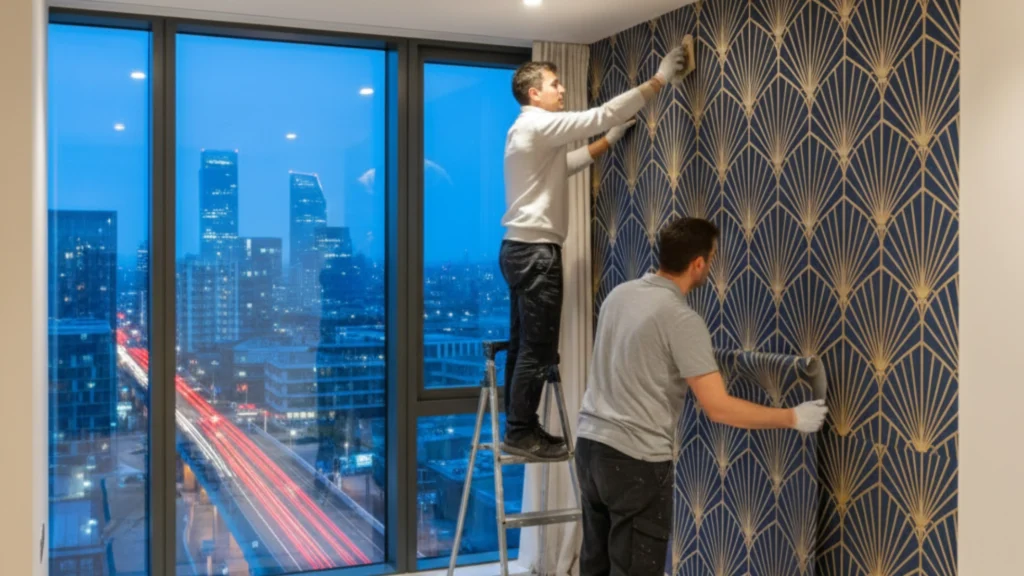
You’ve chosen the wallpaper. Spent weeks deciding. Visited three different showrooms. Ordered samples. Stuck them on the wall and lived with them for two weeks before committing. Beautiful pattern. Subtle geometric design that catches the light beautifully and transforms your living room from a painted box into something genuinely distinctive.
You’ve even done your research. Watched the YouTube videos. Understand the basics. Measure twice, cut once. Overlap the edges slightly. Smooth out bubbles from the centre outward. Simple enough that a reasonably competent adult should be able to manage it on a Saturday afternoon.
So you hire a painter who says they do wallpaper too. They turn up Saturday morning with a paste brush, a seam roller, and an air of confidence that suggests they’ve hung wallpaper before. They strip the existing paint off your walls, paste the first strip, hang it, smooth it down. Looks good. Paste the second strip. Hang it next to the first. Also looks good.
By the fourth strip you notice something. The pattern isn’t quite matching where the strips meet. Not dramatically wrong. Just subtly off. The geometric repeat that should line up precisely across the seams has a slight shift that becomes more obvious the further across the room you look. By the time they reach the far wall, the pattern has drifted enough that anyone looking across the room with any attention to detail can see the installation isn’t right.
Then the bubbles start appearing. Not immediately. Three days later. Small air pockets trapped between the wallpaper and the wall surface that expand as the paste dries and the paper adjusts to the room temperature. Some flatten out. Some don’t. The ones that don’t become permanent features of your living room that catch the light every single evening.
Welcome to the expensive disappointment of hiring painters who happen to do wallpaper rather than wallpaper hangers who genuinely understand installation. Wallpaper hanging isn’t painting with an extra step. It’s a completely different discipline requiring specific technique, specific understanding of pattern matching mathematics, and genuine respect for a material that punishes every single mistake permanently.
I’ve spent ten years hanging wallpaper across Canary Wharf and Isle of Dogs. Getting it genuinely right requires understanding that wallpaper is the least forgiving surface you can put on a wall because every error is visible permanently and cannot be painted over without destroying the entire point of having wallpaper in the first place.
Why Wallpaper Hanging Is Its Own Discipline
Painting a wall and wallpapering a wall look like similar jobs from a distance. Both involve covering a flat surface with something new. But the skills, the preparation requirements, the mathematics involved, and the consequences of failure are fundamentally different in ways that only become obvious once something goes wrong.
Pattern matching is genuinely mathematical. Random pattern wallpapers have no repeat and require no matching. Every other pattern wallpaper has a repeat distance, the measurement between identical points in the pattern, that determines exactly where each strip must be cut to maintain continuous pattern flow across the room. Calculating this repeat across an entire room, accounting for corners, features, and the inevitable waste that pattern matching creates, requires understanding pattern mathematics that painting simply never demands.
Painters who hang wallpaper occasionally work out pattern matching by eye. It works sometimes. It fails consistently on complex patterns, large repeats, and rooms where the pattern needs to flow seamlessly across multiple walls. Professional wallpaper hangers calculate pattern matching precisely before cutting a single strip because they understand that eyeballing a geometric repeat produces visible drift across any room larger than a cupboard.
The wall surface preparation is dramatically more demanding than for painting. Paint is enormously forgiving of minor surface imperfections. A small bump under emulsion is invisible. A small bump under wallpaper creates a visible ridge that catches light and draws the eye constantly. Wallpaper conforms to whatever surface exists underneath it. If that surface isn’t genuinely smooth and properly prepared, the wallpaper shows it permanently.
This means wallpaper preparation requires achieving a surface standard that painting preparation simply never needs to reach. Every imperfection needs addressing because every imperfection will be visible through the wallpaper once it’s on the wall.
The paste application and smoothing technique determines everything. Too much paste creates bubbles that expand as they dry. Too little paste creates dry spots where the paper lifts away from the wall. Smoothing technique that traps air creates permanent bubbles regardless of paste quantity. Smoothing technique that stretches the paper distorts the pattern. Getting all of these elements right simultaneously requires specific wallpaper hanging technique that cannot be learned from painting experience alone.
Mistakes cannot be painted over. A wall painted badly can be repainted. A wall wallpapered badly needs stripping back to bare surface and starting completely over. The consequences of wallpaper installation errors are significantly more expensive to correct than painting errors because the remediation involves removing everything and beginning again rather than simply applying another coat.
The Canary Wharf Wallpaper Challenge
E14 flats present specific wallpaper installation challenges that intensify every general difficulty considerably.
The wall surfaces in managed developments vary enormously. Some Canary Wharf flats have smooth plastered walls perfect for wallpaper installation. Some have textured surfaces from previous treatments that show through wallpaper unless properly skim coated first. Some have multiple layers of previous paint creating an uneven surface that needs thorough preparation before wallpaper will sit flat against it.
Wallpaper hangers who assess wall condition properly before starting produce results that look genuinely professional. Painters who hang wallpaper occasionally discover surface problems partway through installation when strips start behaving unexpectedly against imperfect surfaces.
The humidity in riverside E14 properties affects wallpaper behaviour. Riverside location means higher ambient humidity than inland London properties. Wallpaper paste takes longer to set in humid conditions. Paper stays more flexible longer, which sounds helpful until you realise it also means strips are more likely to shift position after hanging if not properly supported until the paste sets fully.
Professional wallpaper hangers in E14 understand this humidity dynamic and adjust their working method accordingly. Painters who hang wallpaper in drier environments and then encounter E14 humidity conditions find strips behaving unexpectedly in ways they haven’t previously experienced.
The building management access windows create time pressure. Wallpaper hanging in managed Canary Wharf buildings requires the same access coordination as any other contractor work. Weekend access permissions, service lift bookings, noise restrictions. These constraints create time windows within which the entire installation must complete, adding pressure that affects technique quality if the hanger isnaces rushed.
A Real Project: The South Canary Wharf Feature Room
Homeowner in South Canary Wharf wanted their dining room transformed with a stunning large-scale botanical pattern wallpaper. Beautiful design, dramatic scale, the kind of statement that completely defines the character of a room. The pattern had a large repeat meaning significant waste on every strip and precise mathematical matching required across every seam.
They hired a painter who listed wallpaper hanging among their services. Talented painter with genuinely impressive wall finishes throughout E14. Had hung wallpaper before on smaller pattern repeats and simpler designs. Had never encountered a large-scale botanical pattern requiring precise mathematical repeat matching across an entire room.
The pattern matching drifted visibly across the room. The repeat on this particular wallpaper was 89 centimetres. This meant every strip needed cutting at a specific point relative to the previous strip to maintain continuous pattern flow. The painter measured the first few strips carefully. By the sixth strip, they were estimating rather than measuring precisely because the mathematics had become tedious and the pattern seemed close enough.
It wasn’t close enough. By the far wall of the dining room, the pattern had drifted noticeably. The botanical motifs that should have flowed seamlessly across the room were visibly offset where strips met. Anyone sitting at the dining table looking across the room could see the installation wasn’t precise.
The wall surface preparation created permanent ridges. The dining room walls had a subtle texture from previous paint layers that the painter hadn’t fully addressed before hanging wallpaper. Two areas where previous filler had been applied created slight ridges invisible under paint but immediately obvious under wallpaper. The large-scale botanical pattern, being relatively light in colour, made these ridges visible from across the room where they caught light and created shadows.
Bubbles appeared along multiple strips within a week. The paste application technique used too much paste on certain sections, creating trapped air pockets that expanded as the paste dried. Several strips developed visible bubbles along their lower sections where paste had pooled before setting. These bubbles were permanent. The only solution was stripping those strips and rehinging them with correct paste application technique.
We stripped and reinstalled the entire room properly. First, thorough wall surface assessment and preparation. Every imperfection addressed to genuinely smooth condition before wallpaper went anywhere near the surface. Filler areas properly sanded flush. Previous paint layers creating texture properly skim coated where necessary.
Pattern repeat calculated precisely for every single strip before cutting began. Every strip cut at the mathematically correct point relative to the previous strip. No estimating. No assuming close enough would work. The mathematics applied consistently across every strip throughout the entire room.
Paste applied in precisely the correct quantity throughout each strip. Smoothing technique that eliminated trapped air without stretching the paper or distorting the pattern. Each strip positioned, smoothed, and supported until paste set fully before moving to the next.
The finished dining room looked genuinely stunning. The botanical pattern flowing seamlessly across every wall as the designer intended. No ridges visible through the paper. No bubbles anywhere. The kind of installation that makes people genuinely stop and compliment the room rather than notice something slightly wrong without being able to identify what it is.
What Professional Wallpaper Hanging Actually Requires
Let me be specific about what genuinely understanding wallpaper installation means in practice.
Precise pattern repeat calculation before any cutting begins. Every strip measured and cut at the mathematically correct point relative to the previous strip. Not estimated. Not eyeballed. Calculated precisely based on the specific repeat distance of the chosen wallpaper. This calculation determines waste, strip sequencing, and how the pattern flows across corners and features throughout the room.
Surface preparation to wallpaper standard, not painting standard. Every imperfection addressed. Every texture flattened. Every previous repair made genuinely flush with surrounding surfaces. The standard required is significantly higher than painting preparation because wallpaper reveals what paint hides. This preparation stage takes considerably longer than painting preparation and the time difference must be reflected properly in any honest quote.
Correct paste quantity and application technique. Too much paste creates bubbles. Too little creates dry spots and lifting. The correct quantity applied evenly across the entire backing of each strip produces results that set flat, remain flat, and stay flat permanently. This technique develops through specific wallpaper experience and cannot be learned from painting experience alone because the material behaves entirely differently under paste application.
Understanding how humidity affects paste setting time. E14’s riverside humidity means paste takes longer to set than in drier environments. Strips need supporting longer before moving to the next one. Working method adjusts to accommodate slower setting without compromising installation quality. Hangers who work at the same pace regardless of humidity conditions produce results that shift and settle unevenly in humid environments.
Choosing Wallpaper That Actually Works In Your Space
The wallpaper selection itself affects installation difficulty significantly and understanding this before committing saves both money and disappointment.
Large pattern repeats create more waste and demand more precision. A wallpaper with a 90 centimetre repeat wastes significantly more material per strip than one with a 30 centimetre repeat. This waste affects both material cost and installation complexity because every strip requires more precise positioning to maintain pattern continuity.
Light colours on textured walls reveal imperfections dramatically. A dark wallpaper on a textured surface might hide minor surface irregularities through colour depth. A light wallpaper on the same surface reveals every single irregularity through the paper. Understanding this relationship between colour, pattern scale, and wall surface condition helps choose wallpaper that suits your actual walls rather than wallpaper that looks stunning in showroom lighting but reveals problems once installed.
Vinyl coated versus lining paper behave completely differently. Vinyl coated wallpapers resist moisture and clean easily but require different paste, different application technique, and different wall preparation to standard wallpapers. Lining paper used as an undercoat before decorative wallpaper smooths surfaces beautifully but adds installation complexity and time. Understanding these material differences before specifying installation prevents mismatched technique that produces poor results.
What to Demand From Wallpaper Hangers
If you want wallpaper installed properly in your E14 flat, these specifics protect your investment and ensure the result genuinely looks professional.
Pattern repeat calculation demonstrated before installation starts. They should show you exactly how each strip will be cut relative to the previous one based on the specific repeat of your chosen wallpaper. If they’re planning to match the pattern by eye as they go, complex repeats will drift visibly across the room.
Wall surface preparation to wallpaper standard confirmed. They should assess and prepare every wall surface before wallpaper goes anywhere near it. If they’re suggesting hanging wallpaper directly over existing paint without thorough surface preparation, imperfections will show through permanently.
Humidity-aware working method for E14 conditions. They should understand that riverside E14 humidity affects paste setting and adjust their working method accordingly. If they’re working at the same pace they’d use in a drier environment, strips may shift before paste sets properly.
Experience with your specific pattern complexity confirmed. Large repeat patterns, geometric designs, and feature wallpapers all demand more precision than simple textured or plain wallpapers. Ask specifically about their experience with patterns of similar complexity to what you’ve chosen.
Get Your Wallpaper Done Properly
Wallpaper installation done correctly transforms a room completely and permanently. Done badly, it creates visible pattern drift, permanent bubbles, and surface ridges that cannot be fixed without stripping everything and starting again.
We specialise in wallpaper installation across Canary Wharf and Isle of Dogs. We calculate pattern repeats precisely. We prepare surfaces to wallpaper standard. We understand E14 humidity conditions and adjust our working method accordingly. And we produce installations that look genuinely professional because every element has been executed with the precision wallpaper genuinely demands.
Call for quote now: 07507 226422 Email: hello@havenedge.co.uk Website: www.havenedge.co.uk