
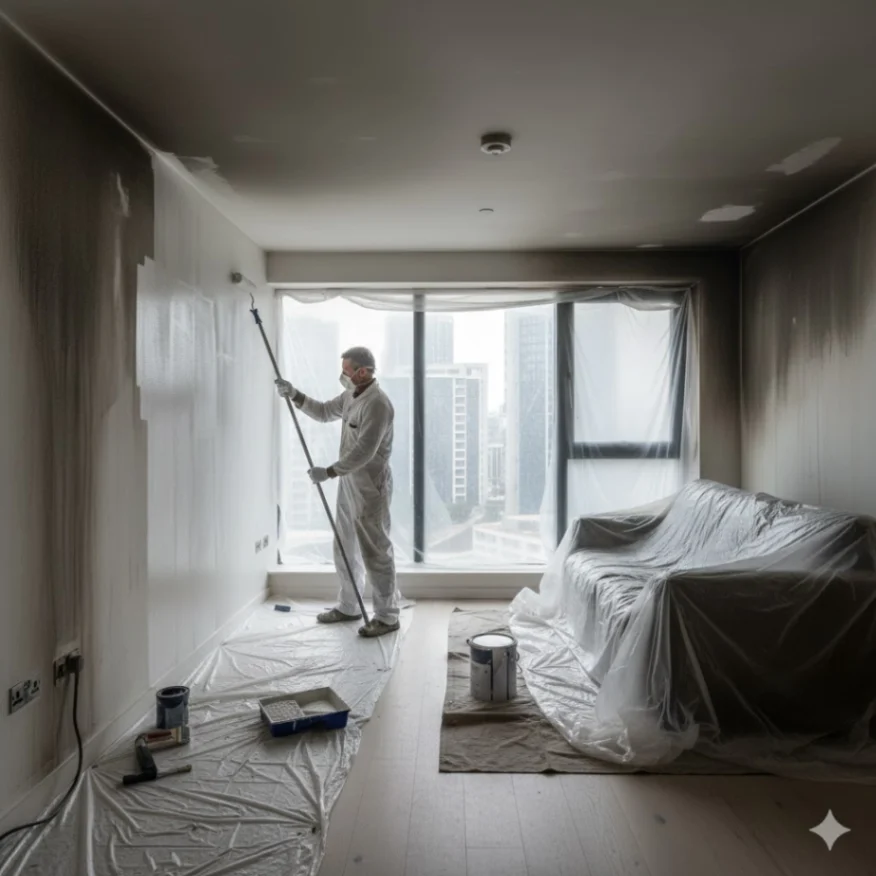
You had a kitchen fire three months ago. Nothing catastrophic. A pan of oil ignited while you were distracted by a phone call. Flames went up the wall behind the hob. You got the fire out quickly with the extinguisher. Building fire alarm went off. Fire brigade attended as protocol. They confirmed everything was safe. No structural damage. Just smoke staining on the kitchen walls and ceiling. Some discolouration spreading into the hallway from where smoke travelled before the extraction cleared it.
Insurance covered the immediate fire damage repairs. New kitchen units where the flames had touched. New hob. New extraction hood. The walls just needed repainting according to the loss adjuster’s assessment. Smoke staining throughout the kitchen and hallway. Straightforward redecoration to restore cosmetic appearance. Nothing structural requiring specialist restoration.
Your insurance-appointed contractor arrived two weeks later. Looked at the smoke staining. Confirmed it was just surface contamination. Applied stain blocking primer. Two coats of fresh white emulsion throughout the affected areas. Kitchen and hallway looked genuinely clean and fresh when the work was completed. No visible smoke staining. No discolouration. Problem apparently sorted.
Three weeks later you notice yellowish brown staining appearing on the kitchen ceiling exactly where the heaviest smoke damage had been. By week five the staining has spread across most of the ceiling despite being completely invisible immediately after painting. The hallway walls are developing similar discolouration in patches where smoke had travelled during the fire. And the smell. The persistent smoke odour that should have been sealed under the paint is still noticeable every time you enter the kitchen.
The staining is bleeding through the fresh paint from contamination within the plaster that standard stain blocking primer couldn’t seal. The smell is emanating from smoke particles embedded in porous surfaces that painting over doesn’t remove or neutralise. You’ve had your flat redecorated and the fire damage is reappearing through the fresh paint as if the redecoration never happened.
Welcome to the expensive failure of treating smoke damage as standard redecoration requiring only stain blocking primer and fresh topcoat. Smoke contamination isn’t surface staining that primer seals. It’s particulate and chemical contamination embedded within porous building materials that continues affecting surfaces above it regardless of how many coats of paint or primer are applied over it.
I’ve spent ten years dealing with fire and smoke damage restoration across Canary Wharf and Isle of Dogs. The number of flats where insurance contractors or painters have treated smoke damage as standard redecoration and discovered contamination bleeding back through within weeks is genuinely alarming because professional smoke damage restoration requires decontamination before any painting begins.
Why Does Smoke Damage Keep Bleeding Through Paint After Fire?
Smoke contamination behaves completely differently to standard staining because smoke is chemically active contamination rather than inert discolouration.
Smoke contains tar, soot, acids, and volatile organic compounds that penetrate into porous materials during fire events. When smoke contacts plaster, paint, or ceiling tiles, these compounds don’t just sit on the surface. They absorb into the porous structure, travelling several millimetres deep into the material depending on smoke exposure duration and intensity.
Standard stain blocking primer seals surface staining by creating a barrier between the stain and topcoat. This works perfectly for water stains, marker pen, or crayon because those contaminants are inert. They sit on or near the surface without chemical activity. Primer blocks them and topcoat covers the primer. Job done.
Smoke contamination is chemically active. The tar and acids within smoke-contaminated plaster continue migrating outward toward surfaces over time. They move through paint layers by chemical action rather than sitting passively underneath them. This migration continues indefinitely until either the contamination is removed from the substrate or specialist sealing treatments chemically neutralise and bind the contamination permanently.
The yellowish brown staining that appears weeks after painting is tar migration. Tar compounds embedded in the plaster migrate through the paint layers and oxidise at the surface, creating the characteristic yellowing that progressively spreads across previously clean-looking painted surfaces.
The persistent odour is volatile organic compounds continuing to off-gas from contaminated materials. Paint doesn’t seal smell. It might reduce odour initially but smoke particles embedded in porous surfaces continue releasing odour molecules that pass through paint layers and pervade the atmosphere regardless of surface coating applied above them.
What’s The Difference Between Light Smoke Staining And Heavy Fire Damage In E14 Flats?
This distinction determines whether painting solutions can work at all or whether contaminated materials need complete removal and replacement.
Light smoke staining from brief exposure or smoke that travelled from another room appears as surface discolouration without substantial penetration into substrate materials. Light staining might be adequately addressed through specialist smoke sealant products without requiring material removal. Testing involves wiping the stained surface with a damp cloth. If substantial discolouration transfers to the cloth, the contamination is primarily surface-based and potentially sealable.
Heavy smoke damage from prolonged direct exposure or intense fire events penetrates deeply into substrate materials. Heavy damage often requires complete removal of contaminated plaster, ceiling tiles, and porous materials because contamination has penetrated beyond what sealing treatments can adequately address. Testing involves the same wipe test. If minimal discolouration transfers to the cloth despite visible staining, the contamination has penetrated deeply into the substrate rather than remaining on the surface.
Canary Wharf flats present specific challenges because modern developments use various ceiling and wall materials. Plasterboard ceilings absorb smoke heavily and often require complete replacement after significant fire events. Concrete walls resist penetration better but textured finishes or previous paint layers create porous surfaces that absorb smoke contamination substantially.
The kitchen fire scenario described above sits in the grey area. Direct fire contact areas need material replacement. Smoke travelled areas might be adequately treated through decontamination and specialist sealing. Making this assessment requires expertise most general painters and even many insurance contractors lack.
A Real Project: The West India Quay Kitchen Fire
Two bed flat near West India Quay. Kitchen fire from electrical fault in the oven. Flames contained to the oven housing and immediate wall area. Smoke spread throughout the kitchen, hallway, and partially into the living room before extraction cleared it. Fire brigade attended. Damage assessed. Kitchen units replaced where fire contacted them. Walls scheduled for redecoration.
Insurance contractor completed the redecoration. Standard stain blocking primer. Two coats of emulsion throughout affected areas. Work completed to apparent satisfaction. Sign-off obtained from the owner.
Five weeks later the owner contacted us. Smoke staining was reappearing through the fresh paint throughout the kitchen ceiling and upper walls.
The decontamination stage had been completely skipped. The contractor had treated smoke damage as surface staining requiring only primer and paint. No cleaning of smoke residue before priming. No testing of contamination depth. No specialist smoke sealant application. Just standard decorating products applied over contaminated surfaces.
The smoke contamination had penetrated substantially into the plasterboard ceiling. The kitchen ceiling was plasterboard rather than concrete. Plasterboard is highly porous and absorbs smoke contamination aggressively during fire events. The tar and acids had penetrated several millimetres into the plasterboard structure, far beyond what surface primer could seal.
The odour persisted despite fresh paint throughout. The flat still smelled of smoke when entering the kitchen despite completely fresh decoration. The smell was emanating from contamination within the ceiling and wall materials that painting over hadn’t removed or neutralised.
We removed and replaced the contaminated ceiling completely. The plasterboard ceiling was too heavily contaminated to seal adequately. Complete removal and replacement with fresh plasterboard was the only reliable solution. The concrete walls were treatable through decontamination because concrete resists penetration better than plasterboard.
Specialist smoke decontamination cleaning throughout the concrete walls. Chemical treatment that breaks down tar and neutralises acids embedded in the surface layer. Multiple cleaning passes until contamination testing confirmed adequate reduction.
Specialist smoke sealant primer applied over cleaned walls. Not standard stain blocking primer. Specialist formulation designed specifically to chemically bind remaining smoke contamination and prevent migration through topcoat. Two coats of emulsion over the smoke sealant primer. The staining hasn’t returned. The odour resolved completely. The kitchen finally felt genuinely restored rather than cosmetically covered.
What Does Professional Smoke Damage Restoration Actually Require?
Proper smoke damage restoration before painting involves specific stages that standard redecoration simply doesn’t include.
Contamination assessment determines treatment approach. Testing contamination depth through surface wiping, odour intensity assessment, and material porosity evaluation. Light contamination might be cleanable and sealable. Heavy contamination requires material removal and replacement. Assuming all smoke damage is identical produces inappropriate treatment.
Decontamination cleaning before any primer or paint. Specialist smoke cleaning chemicals that break down tar, neutralise acids, and remove soot from contaminated surfaces. Multiple cleaning passes until testing confirms adequate contamination reduction. This stage cannot be skipped or replaced with standard cleaning because smoke contamination requires chemical treatment rather than simple washing.
Odour testing after cleaning confirms whether contamination levels have reduced adequately. If smoke odour persists strongly after decontamination cleaning, the contamination has penetrated beyond what cleaning can address and material replacement becomes necessary.
Specialist smoke sealant primer application after cleaning. Not standard stain blocking primer. Smoke-specific sealant formulations that chemically bind remaining contamination and prevent migration through topcoat. Standard primers cannot adequately seal smoke contamination regardless of coat number.
Standard topcoat application over smoke sealant creates the final finish. Once contamination is cleaned and sealed properly, standard emulsion produces lasting results. The topcoat isn’t fighting contamination because the preparation stages have addressed it before painting began.
What Should E14 Residents Demand From Fire Restoration Contractors?
Contamination depth assessment before any treatment begins. They should test whether contamination is surface-based or has penetrated substantially into materials before proposing treatment approach. If they’re proposing painting without assessing contamination depth, they’re guessing at whether sealing will work.
Decontamination cleaning confirmed as separate stage before priming. Not painting over smoke staining. Specialist chemical cleaning that removes contamination before sealing. If their specification goes straight to primer without decontamination cleaning, contamination will bleed through regardless of primer type.
Specialist smoke sealant primer specified explicitly. Not standard stain blocking primer. Smoke-specific products designed to chemically bind tar and prevent migration. If they’re proposing standard stain blocker for smoke damage, bleeding will occur within weeks of completion.
Material replacement recommended for heavily contaminated porous surfaces. Plasterboard ceilings and heavily affected plaster often cannot be adequately cleaned and sealed. If they’re proposing to paint heavily smoke-damaged plasterboard without replacement, failure is likely.
Get Your Fire Damage Actually Restored
Smoke damage restoration requires understanding that contamination isn’t surface staining that primer seals. It’s chemical contamination embedded in porous materials that continues migrating and off-gassing regardless of paint layers applied above it. Professional restoration addresses contamination before painting rather than hoping paint will hide it.
We specialise in smoke damage restoration across Canary Wharf and Isle of Dogs. We assess contamination depth properly. We decontaminate before sealing. We specify smoke-specific sealant products. And we recommend material replacement where contamination cannot be adequately treated through cleaning and sealing alone.
Call for quote now: 07507 226422 Email: hello@havenedge.co.uk Website: www.havenedge.co.uk
CSCS certified, fully insured, experienced with fire and smoke damage restoration across E14. Your flat deserves proper decontamination and specialist sealing rather than standard redecoration that fails within weeks.