
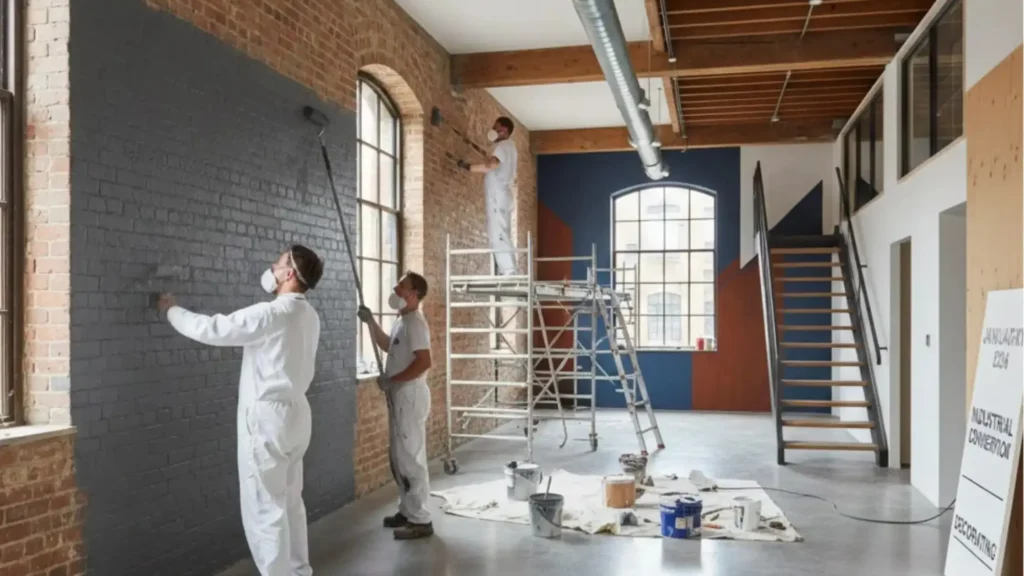
You bought your Isle of Dogs warehouse conversion because you fell in love with the character. The exposed brick. The original steel beams. The massive industrial windows letting light flood through. The sheer volume of the space, those soaring ceilings that make you feel like you’re living in something genuinely special.
Now you want it painted. Specifically, you want the exposed brick sealed and given a subtle finish. The steel beams need treating. The concrete feature wall needs something protective but not too shiny. And the plastered sections where the conversion created bedrooms need standard emulsion.
You hire a painter who specializes in flats. They arrive, look around, and immediately start mixing their standard emulsion for the walls. You mention the brick needs sealing. They shrug. “Yeah, we’ll slap some paint on it.” You mention the steel beams need specialist treatment. They haven’t got anything for steel in the van. They’ll “sort something out.” You mention the concrete wall needs a specific protective coating. They’ve never done concrete before but they’re sure it’ll be fine.
Three weeks later, the sealed brick is already peeling because nobody used appropriate brick sealer. The steel beams are developing rust spots because standard paint on untreated steel does absolutely nothing to protect the metal. The concrete wall has absorbed paint unevenly, creating patches that look amateur and unprofessional.
Welcome to the expensive disaster of hiring standard residential painters for warehouse conversions. These properties aren’t flats with character. They’re industrial buildings that have been converted, and every original surface requires completely different treatment.
I’ve spent ten years painting warehouse conversions across Isle of Dogs and E14. The number of these incredible spaces I’ve seen damaged by painters who treat them like ordinary flats is genuinely painful to think about.
Why Warehouse Conversions Are Their Own Category
A warehouse conversion isn’t a flat with interesting walls. It’s an industrial building that happens to now contain bedrooms and a kitchen. The original industrial surfaces have their own chemistry, their own behavior, and their own requirements.
Multiple substrates in one space. A typical warehouse conversion might contain exposed brick, rendered brick, bare concrete, steel structural elements, timber beams, modern plasterboard, and specialist architectural finishes, all visible simultaneously. Each requires completely different paint, primer, and preparation.
Standard residential painters work with one substrate type. Maybe two. Warehouse conversion specialists must understand six or seven different materials and how they each behave under paint.
The industrial surfaces have history. Original warehouse walls absorbed decades of industrial activity. Oil, chemicals, dust, moisture. These residues affect paint adhesion dramatically. A brick wall that looks clean might have invisible chemical contamination from its previous industrial life that causes paint to fail.
Proper assessment and treatment of industrial surfaces is specialist knowledge. Residential painters have zero experience with this because they’ve never painted anything that was previously a factory or storage facility.
The character needs preserving, not covering. People buy warehouse conversions specifically for the industrial character. They want exposed brick to look like exposed brick, not disappear under layers of paint. They want steel beams to look like steel beams, not get buried under emulsion.
The painting challenge is enhancing and protecting these features while respecting their authenticity. Covering them defeats the entire purpose of living in a conversion rather than a standard flat.
The scale changes everything. Warehouse conversions typically have ceilings between five and seven metres high. Sometimes higher. This isn’t just “tall ceilings.” It’s genuinely industrial scale that requires proper access equipment, different working methods, and significantly more time than standard residential work.
Painters who underestimate the scale end up with inadequate equipment, unrealistic timelines, and incomplete work.
The Isle of Dogs Warehouse Challenge
E14’s warehouse conversions present specific complications beyond generic conversion issues.
These buildings are genuinely old industrial structures. Isle of Dogs was working dockland. These warehouses stored goods, processed materials, housed machinery. The walls, floors, and structures absorbed over a century of industrial use. Understanding what was previously done in these spaces affects how you treat them now.
Painters who don’t understand industrial heritage treat warehouse walls like ordinary masonry. The residual chemistry from previous use causes failures they can’t explain.
Damp patterns are different. Warehouses weren’t designed to be heated or to manage residential moisture levels. The conversion creates new moisture dynamics in structures built for completely different purposes. Damp appears in unexpected places because the building wasn’t originally designed to handle domestic moisture.
Specialist conversion painters understand these unusual damp patterns. Residential painters see damp and apply residential solutions that don’t address conversion specific causes.
Planning and conservation considerations. Many Isle of Dogs conversions sit in areas with planning restrictions about preserving industrial character. Painting over original features or dramatically altering the appearance might have planning implications.
Professional conversion painters understand these restrictions. Generic painters don’t consider them.
The mixing of old and new. Original industrial surfaces sit alongside modern conversion additions. These different materials expand and contract at different rates, move differently with temperature changes, and respond completely differently to moisture. Paint systems must accommodate these differences without failing at the junctions.
This requires understanding material science in ways that standard residential painting simply doesn’t demand.
A Real Project: The Clinton Street Warehouse
Here’s a project that demonstrates exactly why warehouse conversion painting needs genuine specialists.
Client had purchased a stunning ground floor warehouse conversion on Clinton Street. Original brick walls throughout the open plan living area. Exposed steel beams running the entire length. A concrete feature wall behind the kitchen island that they wanted to become the visual focal point. Modern plasterboard partition walls creating bedroom areas.
They hired a painter with excellent reviews who did beautiful work on luxury Canary Wharf flats. Portfolio looked incredible. Skills clearly genuine. But everything in that portfolio was standard residential surfaces.
The brick assessment went wrong immediately. The painter looked at the exposed brick and suggested simply painting it white for a “clean, modern look.” Client wanted sealed and subtly finished, preserving the brick appearance. The painter had never sealed brick before and wasn’t entirely sure what product to use.
Eventually sourced a brick sealer but didn’t properly clean the brick surface first. Decades of dust, cobwebs in the mortar joints, and invisible industrial residue from the building’s previous life meant the sealer couldn’t bond properly to the surface underneath.
The steel beams became a nightmare. The painter applied standard exterior gloss to the steel beams because “it’s meant for metal.” Standard exterior paint on structural steel without proper metal primer and appropriate treatment provides essentially zero protection.
Within weeks, moisture condensation on the cold steel was causing rust to develop underneath the paint. The paint was already bubbling in spots where rust was forming beneath it.
The concrete wall failed completely. The painter used standard emulsion on bare concrete. Concrete is incredibly porous. It absorbed the emulsion unevenly, creating obvious patchy coverage that looked amateur despite the painter’s genuine skill on other surfaces.
Concrete requires specific sealing, appropriate primer for highly porous substrates, and specialist paint designed for concrete surfaces. Standard emulsion on concrete simply cannot produce even coverage because the substrate absorbs paint unpredictably.
We stripped everything back. Properly cleaned the brick, removing decades of industrial residue from mortar joints and surface. Applied appropriate brick sealer after thorough preparation. The difference in adhesion was immediately obvious.
Stripped the steel beams back to bare metal. Applied proper metal primer designed for structural steel. Then applied specialist metal finish appropriate for interior exposed beams. Rust completely eliminated.
The concrete wall required proper concrete primer after surface preparation, followed by specialist concrete paint that handles the substrate’s porosity correctly. Three coats produced genuinely even, professional coverage.
The plastered partition walls got standard treatment because they are standard surfaces. Everything else got specialist treatment because everything else is specialist.
Same property, same skill level required for the modern sections, completely different knowledge required for the original industrial surfaces. The previous painter was genuinely talented. They simply had zero experience with industrial substrates and didn’t know what they didn’t know.
What Warehouse Conversion Painting Actually Requires
Let me be specific about what specialist conversion knowledge involves.
Industrial surface assessment. Before any paint goes anywhere, every original surface needs proper assessment. What material is it? What’s its history? What residues might be present? What condition is it actually in beneath the visible surface?
Residential painters skip this assessment entirely because they’ve never needed to do it. Conversion specialists do it automatically because we know industrial surfaces hide problems.
Substrate specific preparation. Brick needs thorough cleaning, mortar joint attention, and specific surface preparation. Steel needs degreasing, rust treatment, and proper metal primer. Concrete needs sealing and appropriate priming for highly porous substrates. Each material has its own preparation requirements that are completely different from each other.
Standard painters use one preparation method for everything. Conversion specialists adapt preparation to each surface individually.
Appropriate material specification. Brick sealer, metal primer, concrete primer, specialist concrete paint, appropriate finishes for each surface type. These are completely different product ranges from standard residential paint.
Knowing which products work on which substrates, and which products are genuinely suitable versus which just claim to work on everything, requires specialist knowledge built through experience.
Access equipment for scale. Five metre plus ceilings require proper scaffolding or mobile elevated work platforms. Not step ladders. Not extension ladders propped against steel beams that might not support the weight.
Conversion painters understand height requirements and bring appropriate equipment. Standard residential painters bring residential equipment that’s inadequate for industrial scale spaces.
Preserving character while improving condition. The goal isn’t making a warehouse conversion look like a new build flat. It’s making the industrial character look its best while protecting and maintaining original surfaces. This requires a different mindset to standard residential painting where perfection means smooth and uniform.
The Design Trend Advantage
Industrial aesthetic is genuinely fashionable right now, which means warehouse conversion painting has become increasingly important.
Exposed brick is everywhere in design magazines. People specifically want this look. But exposed brick that’s been poorly sealed or painted looks terrible and ruins the aesthetic. Properly treated exposed brick looks stunning and lasts for decades.
Visible steel is a design feature. Black or dark finished steel beams add tremendous visual impact to conversion spaces. Properly treated steel maintains this look indefinitely. Improperly treated steel develops rust that destroys the aesthetic within months.
Concrete as design material. Polished concrete floors and concrete feature walls are genuinely popular in luxury conversions. These surfaces need specialist treatment to look intentionally designed rather than accidentally unfinished.
Understanding these design trends alongside the technical requirements of treating industrial surfaces puts conversion specialists in a unique position.
What to Demand From Warehouse Conversion Painters
If you own a conversion, verify these specifics before hiring.
Experience with multiple industrial substrates. Not just “we’ve done conversions before.” Specific experience with brick sealing, steel treatment, and concrete finishing. Ask them to explain their approach for each surface in your property.
Proper surface assessment before quoting. Anyone who quotes without thoroughly examining every original surface doesn’t understand conversions. Industrial substrates hide problems that only proper assessment reveals.
Specialist material knowledge. They should specify exactly which products they’re using for each surface and why. If they’re proposing standard residential products for industrial surfaces, they don’t understand the work.
Appropriate access equipment. For any ceiling above three metres, verify they’re bringing proper equipment. Step ladders against steel beams in conversion spaces is genuinely dangerous.
Character preservation philosophy. They should understand that the goal is enhancing industrial features, not covering them. If their instinct is to make everything look like a standard flat, they’re wrong for conversion work.
Get Proper Conversion Expertise
Warehouse conversion painting requires understanding industrial substrates, specialist material knowledge, appropriate access for large scale spaces, and a philosophy of preserving rather than covering original character.
We specialize in Isle of Dogs and E14 warehouse conversions. We understand brick sealing, steel treatment, concrete finishing, and how to work with the unique material mix these incredible spaces present.
Call for quote now: 07507 226422 Email: hello@havenedge.co.uk Website: www.havenedge.co.uk
CSCS certified, fully insured, experienced with industrial substrates and conversion specific challenges. Every original surface gets assessed individually and treated with appropriate specialist methods.
Whether full conversion decoration, treating original industrial features, or correcting previous work that didn’t understand these unique spaces, warehouse conversions deserve painters who genuinely understand what makes them special.